So, random blurb having just scanned facebook..... I'm amazed at how much we will force other people to suffer in an attempt to protect ourselves. It's so freakishly arrogant.
Fear-mongering, by the way, is an excellent way to steal the people's rights and enrich the bloated power of ungodly governments. Kudos to President François Hollande for not only keeping his word but for allowing the facts to inform his decisions. May the Lord bless the work of his hands.
Monday, November 23, 2015
Wednesday, November 18, 2015
Christians and the Temple
Christians need the Temple.
Yes, I'm talking about that Temple, the one that Solomon built. We need it back. In fact, we need it back as much as the Jews need it, and we need it because the Jews need it.
Christianity is a "landed" religion. God called humanity to Himself and made two covenants with us- that we shall have authority over this earth and that we shall observe the Sabbath. Then He called the Jews to Himself and made a covenant with them, promising them their own special land out of all the earth.
It was in that land that the Temple was built, and it shall be rebuilt there.
And we need it.
Christians really like rituals and holy places. This is a good thing, since humans were designed to like rituals and holy places, and it is good for Christians to behave like humans. Behaving like anything else would just be silly.
Have you noticed that Christians spend a lot of time and money trying to build little temples? We miss the Temple, and we try to fill our longing with a substitute. Oh, sure, we'll do other things inside these special buildings to prove to ourselves that aren't actually temples, like martial arts clubs and children's games and knitting circles. But we are very careful do those things outside our special times, dividing up our little temples into rooms that are holy sometimes and secular the rest of the time.
It's that division that alerts us to our need for the Temple. It points out to us that we want a special place to meet with God where we lay down our mundane human activities and follow a ritual that lets us feel....different. Special. Maybe even holy.
I think we should cultivate that desire. We should set up shrines in our homes where we practice personal worship, and we should pray for the day when we will gather at the Temple to practice corporate worship.
I don't think our little temples cut it. They just don't work. And not only are they dissatisfactory as temples, they numb us to the desire that would drive to pray for our Lord's return. If we would let that desire awaken in us, we would feel pain, and we would rightly feel our need for Israel to prosper and conquer. We need the Temple back. We could use that need as motivation to forge relationships that glorify God. We could allow our need to drive us to Him, to our knees, and to our brothers. We could allow ourselves to feel our need, and then the peace that comes with the faith that God will one day meet that need.
Or we can create counterfeits that allow us to ignore the need. I've been the witness to many counterfeits, and, let me tell you, they aren't worth it. Counterfeits never are.
So I'm going wait and hope and pray for the rebuilding of the Temple. I need it to be rebuilt. I need God to answer this longing in my heart. And until He does, I'll wait and pray and lean on Him. I am part of the Dispersion. My land has been overrun with godless men and I can't go home. Not yet.
But one day, one day I will get to go home. That will be a good day.
Yes, I'm talking about that Temple, the one that Solomon built. We need it back. In fact, we need it back as much as the Jews need it, and we need it because the Jews need it.
Christianity is a "landed" religion. God called humanity to Himself and made two covenants with us- that we shall have authority over this earth and that we shall observe the Sabbath. Then He called the Jews to Himself and made a covenant with them, promising them their own special land out of all the earth.
It was in that land that the Temple was built, and it shall be rebuilt there.
And we need it.
Christians really like rituals and holy places. This is a good thing, since humans were designed to like rituals and holy places, and it is good for Christians to behave like humans. Behaving like anything else would just be silly.
Have you noticed that Christians spend a lot of time and money trying to build little temples? We miss the Temple, and we try to fill our longing with a substitute. Oh, sure, we'll do other things inside these special buildings to prove to ourselves that aren't actually temples, like martial arts clubs and children's games and knitting circles. But we are very careful do those things outside our special times, dividing up our little temples into rooms that are holy sometimes and secular the rest of the time.
It's that division that alerts us to our need for the Temple. It points out to us that we want a special place to meet with God where we lay down our mundane human activities and follow a ritual that lets us feel....different. Special. Maybe even holy.
I think we should cultivate that desire. We should set up shrines in our homes where we practice personal worship, and we should pray for the day when we will gather at the Temple to practice corporate worship.
I don't think our little temples cut it. They just don't work. And not only are they dissatisfactory as temples, they numb us to the desire that would drive to pray for our Lord's return. If we would let that desire awaken in us, we would feel pain, and we would rightly feel our need for Israel to prosper and conquer. We need the Temple back. We could use that need as motivation to forge relationships that glorify God. We could allow our need to drive us to Him, to our knees, and to our brothers. We could allow ourselves to feel our need, and then the peace that comes with the faith that God will one day meet that need.
Or we can create counterfeits that allow us to ignore the need. I've been the witness to many counterfeits, and, let me tell you, they aren't worth it. Counterfeits never are.
So I'm going wait and hope and pray for the rebuilding of the Temple. I need it to be rebuilt. I need God to answer this longing in my heart. And until He does, I'll wait and pray and lean on Him. I am part of the Dispersion. My land has been overrun with godless men and I can't go home. Not yet.
But one day, one day I will get to go home. That will be a good day.

Have a Pangolin
Happy Wednesday!

"Pangolins (also referred to as scaly anteaters or trenggiling) are mammals of the order Pholidota. The one extant family, Manidae, has three genera, Manis which comprises four species living in Asia, Phataginus which comprises two species living in Africa, and Smutsia which comprises two species also living in Africa. These species range in size from 30 to 100 centimetres (12 to 39 in). A number of extinct pangolin species are also known. The name pangolin comes from the Malay word "pengguling", meaning "something that rolls up". It is found naturally in tropical regions throughout Africa and Asia.
Pangolins have large, protective keratin scales covering their skin; they are the only known mammals with this adaptation. They live in hollow trees or burrows, depending on the species. Pangolins are nocturnal, and their diet consists of mainly ants and termites which they capture using their long, specially adapted tongues. They tend to be solitary animals, meeting only to mate and produce a litter of one to three offspring which are raised for about two years. Pangolins are threatened by hunting (for their meat and armor) and heavy deforestation of their natural habitats. They are the most trafficked mammal in the world. All eight pangolin species are listed as threatened on the IUCN Red List of Threatened Species."
"Most pangolins are nocturnal animals that use their well-developed sense of smell to find insects. The long-tailed pangolin is also active by day, while other species of pangolins spend most of the daytime sleeping, curled up into a ball.
Arboreal pangolins live in hollow trees, whereas the ground dwelling species dig tunnels underground, to a depth of 3.5 metres (11 ft). Pangolins are also good swimmers.
Indian pangolin defending itself against Asiatic lions
Pangolins are insectivorous. Most of their diet consists of various species of ants and termites and may be supplemented by other insects, especially larvae. They are somewhat particular and tend to consume only one or two species of insects, even when many species are available to them. A pangolin will consume an average of 140 to 200 g (4.9 to 7.1 oz) of insects per day.
Pangolins have a very poor sense of vision, and therefore rely heavily on smell and hearing. After locating their prey, they tear open the anthills or termite mounds with their powerful front claws. Their front claws are so large that their front feet are not useful for walking. The animal uses its long tail to counterbalance its torso as it walks on its two hind legs. After tearing open the ant or termite mound, it uses its long tongue to probe inside the insect tunnels and retrieve its prey. They have glands in their chests to lubricate the tongue with sticky, ant-catching saliva. The tongue extends all the way into a cavity of the abdomen and is longer than the pangolin's entire body length. Pangolins lack teeth and, therefore, the ability to chew, however, they ingest small stones while foraging, which accumulate in the muscular stomach and help to grind up ants.
Some species, such as the tree pangolin, use their strong, prehensile tails to hang from tree branches and strip away bark from the trunk, exposing insect nests inside."
~Wikipedia.org

"Pangolins (also referred to as scaly anteaters or trenggiling) are mammals of the order Pholidota. The one extant family, Manidae, has three genera, Manis which comprises four species living in Asia, Phataginus which comprises two species living in Africa, and Smutsia which comprises two species also living in Africa. These species range in size from 30 to 100 centimetres (12 to 39 in). A number of extinct pangolin species are also known. The name pangolin comes from the Malay word "pengguling", meaning "something that rolls up". It is found naturally in tropical regions throughout Africa and Asia.
Pangolins have large, protective keratin scales covering their skin; they are the only known mammals with this adaptation. They live in hollow trees or burrows, depending on the species. Pangolins are nocturnal, and their diet consists of mainly ants and termites which they capture using their long, specially adapted tongues. They tend to be solitary animals, meeting only to mate and produce a litter of one to three offspring which are raised for about two years. Pangolins are threatened by hunting (for their meat and armor) and heavy deforestation of their natural habitats. They are the most trafficked mammal in the world. All eight pangolin species are listed as threatened on the IUCN Red List of Threatened Species."
"Most pangolins are nocturnal animals that use their well-developed sense of smell to find insects. The long-tailed pangolin is also active by day, while other species of pangolins spend most of the daytime sleeping, curled up into a ball.
Arboreal pangolins live in hollow trees, whereas the ground dwelling species dig tunnels underground, to a depth of 3.5 metres (11 ft). Pangolins are also good swimmers.
Indian pangolin defending itself against Asiatic lions
Pangolins are insectivorous. Most of their diet consists of various species of ants and termites and may be supplemented by other insects, especially larvae. They are somewhat particular and tend to consume only one or two species of insects, even when many species are available to them. A pangolin will consume an average of 140 to 200 g (4.9 to 7.1 oz) of insects per day.
Pangolins have a very poor sense of vision, and therefore rely heavily on smell and hearing. After locating their prey, they tear open the anthills or termite mounds with their powerful front claws. Their front claws are so large that their front feet are not useful for walking. The animal uses its long tail to counterbalance its torso as it walks on its two hind legs. After tearing open the ant or termite mound, it uses its long tongue to probe inside the insect tunnels and retrieve its prey. They have glands in their chests to lubricate the tongue with sticky, ant-catching saliva. The tongue extends all the way into a cavity of the abdomen and is longer than the pangolin's entire body length. Pangolins lack teeth and, therefore, the ability to chew, however, they ingest small stones while foraging, which accumulate in the muscular stomach and help to grind up ants.
Some species, such as the tree pangolin, use their strong, prehensile tails to hang from tree branches and strip away bark from the trunk, exposing insect nests inside."
~Wikipedia.org
Anti-Confederate Flagism is Hypocritical
Here is why I think that the rush to alienate ourselves from the Confederate Flag and the "hate" it stands for is hypocritical and straight up silly:
Anyone who proudly waves the American flag is promoting
There is no flag on this planet that does not have a story of hate in it's history. We do not raise our nation's flag as a symbol of righteousness, but as a symbol of the identity of our people. That identity may be founded on the blood of the innocent, but whose isn't? If we're running a competition for who has the least guilty flag, we will all fail, "for all have sinned and come short of the glory of God." (Rom 3:23) Rejecting our history because we don't like our past selves is ludicrous. How are we to learn from the past if we erase it? In my opinion, those who are hating on people for flying the "Confederate" flag are simply indulging the crime they claim they're fighting against - hate. Be wary of the man who preaches too loudly against a particular sin, for it is likely you will find that sin living comfortably behind his door.
Anyone who proudly waves the American flag is promoting
- A nation that is founded on the bodies of the indigenous peoples of this land
- A nation that imported slaves that had been sold to her by their neighbors
- A nation that put unity over righteousness
- A nation that apathetically stood to the sidelines as Europe was enveloped by the insatiable greed of tyrants
- A nation that turned a blind eye to genocides because war was too costly
- A nation that topples and establishes the governments of madmen to ensure a continued supply of oil
- A nation that currently houses one of the worlds largest hub for human trafficking
- A nation that consumes so much that even though she makes up only 5% of the world's population, she consumes 24% of it's wealth
- A nation that produces so much waste that she pays other nations to deal with it because she's run out of burial grounds
- A nation so self-centered that she murders millions of her own offspring so she can continue her life of indulgence
- A nation that burns millions of acres of food in order to keep it's market "stable" while some 25,000 people every day to hunger related problems
There is no flag on this planet that does not have a story of hate in it's history. We do not raise our nation's flag as a symbol of righteousness, but as a symbol of the identity of our people. That identity may be founded on the blood of the innocent, but whose isn't? If we're running a competition for who has the least guilty flag, we will all fail, "for all have sinned and come short of the glory of God." (Rom 3:23) Rejecting our history because we don't like our past selves is ludicrous. How are we to learn from the past if we erase it? In my opinion, those who are hating on people for flying the "Confederate" flag are simply indulging the crime they claim they're fighting against - hate. Be wary of the man who preaches too loudly against a particular sin, for it is likely you will find that sin living comfortably behind his door.
God's Will, Temptation, Trails and Fairness
"God Will Give You More than You Can Handle"
http://www.thegospelcoalition.org/article/god-will-give-you-more-than-you-can-handle
"Christians can make the strangest claims when comforting those who are suffering. What do you say to someone whose life is falling apart? If you have but few precious minutes with a person who’s lost a job, home, spouse, child, or all sense of purpose, what comfort do you give?
We might turn to conventional wisdom instead of Scripture and end up saying something like, “Don’t worry, this wouldn’t happen in your life if God didn’t think you could bear it.” The sufferer may object, head shaking and hands up. But you insist, “Look, seriously, the Bible promises God won’t ever give you more in life than you can handle.” There it is—conventional wisdom masquerading as biblical truth. You’ve promised what the Bible never does."
I like this article. It says what I've always felt and couldn't articulate. It is very, very comforting for me.
http://www.thegospelcoalition.org/article/god-will-give-you-more-than-you-can-handle
"Christians can make the strangest claims when comforting those who are suffering. What do you say to someone whose life is falling apart? If you have but few precious minutes with a person who’s lost a job, home, spouse, child, or all sense of purpose, what comfort do you give?
We might turn to conventional wisdom instead of Scripture and end up saying something like, “Don’t worry, this wouldn’t happen in your life if God didn’t think you could bear it.” The sufferer may object, head shaking and hands up. But you insist, “Look, seriously, the Bible promises God won’t ever give you more in life than you can handle.” There it is—conventional wisdom masquerading as biblical truth. You’ve promised what the Bible never does."
I like this article. It says what I've always felt and couldn't articulate. It is very, very comforting for me.
Lichens and Green House Gases?
http://beforeitsnews.com/science-and-technology/2015/07/new-source-of-greenhouse-gases-discovered-2774796.html
"Inconspicuous creatures surprise with a property that is important for our climate: Lichens, mosses and cyanobacteria release large quantities of the greenhouse gas nitrous oxide (N2O), also known as laughing gas, and low quantities of methane (CH4) into the atmosphere."

Yay! Lichens and mosses are totally rad.
And no, I don't believe in "global warming," as defined by the media. The earth is trying to reach equilibrium the same way everything else is, which means cycling in and out of cold and hot extremes, with those extremes getting closer and closer to each other. It is a big deal and will lead to extinctions and plagues, but there's not really much we can do to stop it. There are other, much more important things we need to address, like the disposal of the massive amounts of waste we produce.
4.3 pounds per person per day x 365 days in a year = 1569.5 pounds per person per year
1569.5 x 318,900,000 (US population) = 116,398,500,000 ~ 116.4 billion pounds of waste per year
That is a man-made problem. That is a problem we can fix. That is a problem we desperately need to fix. And that is the problem that media doesn't really talk about.
"Inconspicuous creatures surprise with a property that is important for our climate: Lichens, mosses and cyanobacteria release large quantities of the greenhouse gas nitrous oxide (N2O), also known as laughing gas, and low quantities of methane (CH4) into the atmosphere."
Yay! Lichens and mosses are totally rad.
And no, I don't believe in "global warming," as defined by the media. The earth is trying to reach equilibrium the same way everything else is, which means cycling in and out of cold and hot extremes, with those extremes getting closer and closer to each other. It is a big deal and will lead to extinctions and plagues, but there's not really much we can do to stop it. There are other, much more important things we need to address, like the disposal of the massive amounts of waste we produce.
4.3 pounds per person per day x 365 days in a year = 1569.5 pounds per person per year
1569.5 x 318,900,000 (US population) = 116,398,500,000 ~ 116.4 billion pounds of waste per year
That is a man-made problem. That is a problem we can fix. That is a problem we desperately need to fix. And that is the problem that media doesn't really talk about.
Microplastics being ingested by Zooplankton
http://www.sciencedaily.com/releases/2015/06/150629133813.htm
"Tiny microscopic animals called zooplankton are ingesting plastic particles at an alarming rate, according to a new study by Dr. Peter Ross, head of the Ocean Pollution Research Program at Vancouver Aquarium Marine Science Centre. That could spell trouble for the entire aquatic food web."
I try not to go all environmentalist on you guys too often, but this is really important. We try to convince ourselves that because plastic in the ocean is being broken down, we're all safe. But it's a lie. Plastic kills. Period. And its extensive use is not due to necessity but to bloated consumerism. Greed.
There are many places that plastics are very useful, and responsible handling of these situations wouldn't leave a scrap in our oceans. But we're not responsible. We're totally depraved, and this is one of the results of that depravity.
Just for fun, here's a picture of how energy is transferred up the food chain.

"Tiny microscopic animals called zooplankton are ingesting plastic particles at an alarming rate, according to a new study by Dr. Peter Ross, head of the Ocean Pollution Research Program at Vancouver Aquarium Marine Science Centre. That could spell trouble for the entire aquatic food web."
I try not to go all environmentalist on you guys too often, but this is really important. We try to convince ourselves that because plastic in the ocean is being broken down, we're all safe. But it's a lie. Plastic kills. Period. And its extensive use is not due to necessity but to bloated consumerism. Greed.
There are many places that plastics are very useful, and responsible handling of these situations wouldn't leave a scrap in our oceans. But we're not responsible. We're totally depraved, and this is one of the results of that depravity.
Just for fun, here's a picture of how energy is transferred up the food chain.
Sociopaths & INTJs
So, I just found out that not all those who lack empathy are sociopaths. It turns out that there is a whole personality set aside all by itself that generally lacks empathy. I find this to be hilarious.
And disturbing. Not because I think this personality type is dangerous, but because I think the oversimplification of the common understanding of sociopathy is dangerous. Stereotypes have their place and are useful in navigating our complex social world, but oversimplifications of highly defined behavior sets can lead to a whole group of people being marginalized, or even ostracized, because of their base personality.
This personality type is good and useful. It is rare, coming in at a mere 2% of the world's population. It is known to its personality system as the Architect, and people of this personality base are extremely intellectual, cunning, precise, curious, energetic and efficient. And they get the best grades in school.
We know that people love this personality type because it makes up an estimated 13% of personality types in fictional literature. Of course, pegging the personality of fictional persons is difficult so take this number with a grain of salt, but also note that the most common personality in this particular personality system is approximately 14% of the global population. Even if the numbers are a little off, it is pretty clear that most people enjoy books with this personality as the lead.
So, please be careful and do your research. Diagnosing someone as a sociopath when all they have is rare personality type could cost you a friend, and could destroy what few chances they have at normal relationships. God created this personality type and has called it "good." Please don't call it evil.
And disturbing. Not because I think this personality type is dangerous, but because I think the oversimplification of the common understanding of sociopathy is dangerous. Stereotypes have their place and are useful in navigating our complex social world, but oversimplifications of highly defined behavior sets can lead to a whole group of people being marginalized, or even ostracized, because of their base personality.
This personality type is good and useful. It is rare, coming in at a mere 2% of the world's population. It is known to its personality system as the Architect, and people of this personality base are extremely intellectual, cunning, precise, curious, energetic and efficient. And they get the best grades in school.
We know that people love this personality type because it makes up an estimated 13% of personality types in fictional literature. Of course, pegging the personality of fictional persons is difficult so take this number with a grain of salt, but also note that the most common personality in this particular personality system is approximately 14% of the global population. Even if the numbers are a little off, it is pretty clear that most people enjoy books with this personality as the lead.
So, please be careful and do your research. Diagnosing someone as a sociopath when all they have is rare personality type could cost you a friend, and could destroy what few chances they have at normal relationships. God created this personality type and has called it "good." Please don't call it evil.
Monday, October 19, 2015

Have a Mantis
Happy Monday!


"The mantises or Mantodea are an order of insects that contains over 2,400 species and about 430 genera in 15 families, by far the largest family being Mantidae ("mantids"). Mantises are distributed worldwide in temperate and tropical habitats. They have triangular heads with bulging eyes supported on flexible necks. The elongated bodies may or may not have wings, but all have forelegs that are greatly enlarged and adapted for catching and gripping prey; their upright posture, while remaining stationary with forearms folded, has led to the name praying mantises.
They are mostly ambush predators, but a few ground-dwelling species actively pursue their prey. They normally live for about a year; in cooler climates, the adults lay eggs in autumn, and die. The eggs overwinter, protected by their hard capsule, and hatch in the spring. Females sometimes practice sexual cannibalism, eating their mate after copulation, or occasionally decapitating the male just before or during mating."
"Mantises are generalist predators of arthropods. The majority of mantises are ambush predators that only feed upon live prey within their reach. They either camouflage themselves and remain stationary, waiting for prey to approach, or stalk their prey with slow, stealthy movements. Larger mantises sometimes eat smaller individuals of their own species, as well as small vertebrates such as lizards and frogs.
'Most mantises chase tempting prey if it strays close enough, and will go further when they are especially hungry. Once within reach, mantises strike rapidly to grasp the prey with their spiked raptorial forelegs. Some ground and bark species pursue their prey in a more active way. For example, members of a few genera such as the ground mantises, Entella, Ligaria and Ligariella run over dry ground seeking prey, much as tiger beetles do."
~Wikipedia.org

"The mantises or Mantodea are an order of insects that contains over 2,400 species and about 430 genera in 15 families, by far the largest family being Mantidae ("mantids"). Mantises are distributed worldwide in temperate and tropical habitats. They have triangular heads with bulging eyes supported on flexible necks. The elongated bodies may or may not have wings, but all have forelegs that are greatly enlarged and adapted for catching and gripping prey; their upright posture, while remaining stationary with forearms folded, has led to the name praying mantises.
They are mostly ambush predators, but a few ground-dwelling species actively pursue their prey. They normally live for about a year; in cooler climates, the adults lay eggs in autumn, and die. The eggs overwinter, protected by their hard capsule, and hatch in the spring. Females sometimes practice sexual cannibalism, eating their mate after copulation, or occasionally decapitating the male just before or during mating."
"Mantises are generalist predators of arthropods. The majority of mantises are ambush predators that only feed upon live prey within their reach. They either camouflage themselves and remain stationary, waiting for prey to approach, or stalk their prey with slow, stealthy movements. Larger mantises sometimes eat smaller individuals of their own species, as well as small vertebrates such as lizards and frogs.
'Most mantises chase tempting prey if it strays close enough, and will go further when they are especially hungry. Once within reach, mantises strike rapidly to grasp the prey with their spiked raptorial forelegs. Some ground and bark species pursue their prey in a more active way. For example, members of a few genera such as the ground mantises, Entella, Ligaria and Ligariella run over dry ground seeking prey, much as tiger beetles do."
~Wikipedia.org
Wednesday, July 29, 2015
Have a Rusty-spotted Cat
Happy Wednesday!

"The rusty-spotted cat (Prionailurus rubiginosus) is one of the cat family's smallest members, and is found only in India and Sri Lanka. It has been listed as Vulnerable by IUCN in 2002 as the total effective population size is estimated at below 10,000 mature individuals, with a declining trend due to habitat loss, and no subpopulation containing more than 1,000 mature breeding individuals.
The rusty-spotted cat rivals the black-footed cat as the world's smallest wild cat. It is 35 to 48 cm (14 to 19 in) in length, with a 15 to 30 cm (5.9 to 11.8 in) tail, and weighs only 0.9 to 1.6 kg (2.0 to 3.5 lb). The short fur is grey over most of the body, with rusty spots over the back and flanks, while the underbelly is white with large dark spots. The darker colored tail is thick and about half the length of the body, and the spots are less distinct. There are six dark streaks on each side of the head, extending over the cheeks and forehead.
Rusty-spotted cats have a relatively restricted distribution. They mainly occur in moist and dry deciduous forests as well as scrub and grassland, but are likely absent from evergreen forest. They prefer dense vegetation and rocky areas.
Very little is known about ecology and behaviour of rusty-spotted cats in the wild. Captive ones are mostly nocturnal but also briefly active during the day. Most wild ones were also recorded after dark. Several individuals were observed hiding in trees and in caves.
They feed mainly on rodents and birds, but may also hunt lizards, frogs, and insects. They hunt primarily on the ground, making rapid, darting movements to catch their prey. They apparently venture into trees to escape larger predators. Captive females and males both scent-mark their home range by spraying urine."
~Wikipedia.org
"The rusty-spotted cat (Prionailurus rubiginosus) is one of the cat family's smallest members, and is found only in India and Sri Lanka. It has been listed as Vulnerable by IUCN in 2002 as the total effective population size is estimated at below 10,000 mature individuals, with a declining trend due to habitat loss, and no subpopulation containing more than 1,000 mature breeding individuals.
The rusty-spotted cat rivals the black-footed cat as the world's smallest wild cat. It is 35 to 48 cm (14 to 19 in) in length, with a 15 to 30 cm (5.9 to 11.8 in) tail, and weighs only 0.9 to 1.6 kg (2.0 to 3.5 lb). The short fur is grey over most of the body, with rusty spots over the back and flanks, while the underbelly is white with large dark spots. The darker colored tail is thick and about half the length of the body, and the spots are less distinct. There are six dark streaks on each side of the head, extending over the cheeks and forehead.
Rusty-spotted cats have a relatively restricted distribution. They mainly occur in moist and dry deciduous forests as well as scrub and grassland, but are likely absent from evergreen forest. They prefer dense vegetation and rocky areas.
Very little is known about ecology and behaviour of rusty-spotted cats in the wild. Captive ones are mostly nocturnal but also briefly active during the day. Most wild ones were also recorded after dark. Several individuals were observed hiding in trees and in caves.
They feed mainly on rodents and birds, but may also hunt lizards, frogs, and insects. They hunt primarily on the ground, making rapid, darting movements to catch their prey. They apparently venture into trees to escape larger predators. Captive females and males both scent-mark their home range by spraying urine."
~Wikipedia.org
Goodbye, Facebook
On July 21, I deactivated my Facebook account. I cannot tell you how much it disturbs me that I do not have the authority to delete my account, but must simply make it inactive, as though it I'm on vacation and will surely be back to continue on as normal.
Which is one reason I deactivated my account; I am sick and tired of Facebook's psychological games.
The deactivation page required that I choose one, and only one, of the following:
Did I mention that I'm tired of their psychological games?
I chose the "Other" option and wrote in the accompanying text box:
"I have concluded that Facebook is no longer a responsible member of my culture and community. Facebook has increasingly encroached on my privacy for the sole purpose of furthering it's own means and has legitimized pornography and the solicitation of prostitution. Facebook has made it clear to me that it has no desire to help people, contribute to or help stabilize legitimate, healthy communities. I don't need Facebook and Facebook certainly does not need me. We have come to the end of this relationship. Farewell."
I will not miss Facebook. I regret the distance, individualism and mass communication that our culture has decided are vital to existence, but Facebook hasn't, and won't, solve those problems. Those ruts are deep and have been in the making for the past five centuries. The philosophical, economic and political overhauls necessary to address the issues of our modern world will only be enacted through personal relationships, and you can't get that via mass communications and social media.
Social sites like Facebook advertise themselves as being able to reunite users with old friends and acquaintances, and let users branch out into wider social circles via their friend's friends. But there are two things that social sites have to ignore into order to keep their users: a) everyone has a friend limit, and b) personal maturation requires moving on. I learned in Psychology 101 that everyone has a limit to the number of people they can interact with on a regular basis. That number is flexible and corresponds to personalities, with introverts requiring fewer friends than extroverts. The average number of acquaintances, friends and close friends that a person can have is ~150. Facebook, and other social media sites, depend on their users increasing their relationship circles beyond that number, and I classify that as corporate abuse. Push, wiggle, cajole, bribe, lie, weasel and manipulate, they are determined to make it look like surrendering one's sanity to their demands will be fun and/or beneficial. I have yet to see a case where it is.
Leaving the past and walking into the future has been a challenge for humanity since the Fall. Grieving the apparent loss of college friends was soothed by the idea that I could poke them, or write on their walls, or send them messages. But the truth is that those relationships died because of distance, even if I lived in denial. There was nothing personal, nothing real, about the way we stalked each other's Facebook pages, scanning gobs of content for something that would make our brains release endorphins. It was fun. And shallow. Over time I realized that I didn't know those people anymore, even though I care so much about them. And I knew that they didn't know me.
Zombie relationships are dead with some semblance of life allowing us to trick ourselves to believing that they are truly alive. It is so hard to let go of a good thing and reach out into the unknown for something as deeply personal and terrifyingly dangerous as a relationship with another human being. It is so much easier to trick ourselves into thinking that time and distance haven't changed anything, and that we don't have to let go of things, and people, that we value. But the zombie relationships I had on Facebook were sapping my time and emotional energy, stealing away what was due to the people with whom I live, work and worship. Feeding zombies is easy, but it is not what God has made us for. We are called to *live*, to grow, risking ourselves on the frontier of a dynamic and self-sacrificial relationship with God. There is a time for everything, and everyone. And when I must part ways with a dear Christian friend, I must take comfort in the knowledge that I will see them again. One day......
But enough ranting for now. You all are here, I value you! I'm intending to spend more time on the phone and writing personal letters, so we'll see how that goes. Blessings!
Which is one reason I deactivated my account; I am sick and tired of Facebook's psychological games.
The deactivation page required that I choose one, and only one, of the following:
- I don't feel safe on Facebook.
- I don't find Facebook useful.
- I have another Facebook account.
- I spend too much time using Facebook.
- I have a privacy concern.
- My account was hacked.
- This is temporary. I'll be back.
- I don't understand how to use Facebook.
- I get too many emails, invitations, and requests from Facebook.
- Other, please explain further:
Did I mention that I'm tired of their psychological games?
I chose the "Other" option and wrote in the accompanying text box:
"I have concluded that Facebook is no longer a responsible member of my culture and community. Facebook has increasingly encroached on my privacy for the sole purpose of furthering it's own means and has legitimized pornography and the solicitation of prostitution. Facebook has made it clear to me that it has no desire to help people, contribute to or help stabilize legitimate, healthy communities. I don't need Facebook and Facebook certainly does not need me. We have come to the end of this relationship. Farewell."
I will not miss Facebook. I regret the distance, individualism and mass communication that our culture has decided are vital to existence, but Facebook hasn't, and won't, solve those problems. Those ruts are deep and have been in the making for the past five centuries. The philosophical, economic and political overhauls necessary to address the issues of our modern world will only be enacted through personal relationships, and you can't get that via mass communications and social media.
Social sites like Facebook advertise themselves as being able to reunite users with old friends and acquaintances, and let users branch out into wider social circles via their friend's friends. But there are two things that social sites have to ignore into order to keep their users: a) everyone has a friend limit, and b) personal maturation requires moving on. I learned in Psychology 101 that everyone has a limit to the number of people they can interact with on a regular basis. That number is flexible and corresponds to personalities, with introverts requiring fewer friends than extroverts. The average number of acquaintances, friends and close friends that a person can have is ~150. Facebook, and other social media sites, depend on their users increasing their relationship circles beyond that number, and I classify that as corporate abuse. Push, wiggle, cajole, bribe, lie, weasel and manipulate, they are determined to make it look like surrendering one's sanity to their demands will be fun and/or beneficial. I have yet to see a case where it is.
Leaving the past and walking into the future has been a challenge for humanity since the Fall. Grieving the apparent loss of college friends was soothed by the idea that I could poke them, or write on their walls, or send them messages. But the truth is that those relationships died because of distance, even if I lived in denial. There was nothing personal, nothing real, about the way we stalked each other's Facebook pages, scanning gobs of content for something that would make our brains release endorphins. It was fun. And shallow. Over time I realized that I didn't know those people anymore, even though I care so much about them. And I knew that they didn't know me.
Zombie relationships are dead with some semblance of life allowing us to trick ourselves to believing that they are truly alive. It is so hard to let go of a good thing and reach out into the unknown for something as deeply personal and terrifyingly dangerous as a relationship with another human being. It is so much easier to trick ourselves into thinking that time and distance haven't changed anything, and that we don't have to let go of things, and people, that we value. But the zombie relationships I had on Facebook were sapping my time and emotional energy, stealing away what was due to the people with whom I live, work and worship. Feeding zombies is easy, but it is not what God has made us for. We are called to *live*, to grow, risking ourselves on the frontier of a dynamic and self-sacrificial relationship with God. There is a time for everything, and everyone. And when I must part ways with a dear Christian friend, I must take comfort in the knowledge that I will see them again. One day......
But enough ranting for now. You all are here, I value you! I'm intending to spend more time on the phone and writing personal letters, so we'll see how that goes. Blessings!
LaVoice Update - We're on the Move!
Hello, Special People!
Logan, Andrew and I have received the invitation to move in with and rent rooms from a young couple in our congregation, the Benedettis. They will be preparing their house to receive us over the next two weeks and we plan to move on Aug 8th. The things that we will not be able to take with us will live in a storage unit.
The hope is that we will be able to work with this arrangement until we can save up enough money to buy a house. As it is, the new management of our apartment complex is raising the rent every year and we won't be able to put aside enough to save up for house if we stay where we are.
Please pray for both parties as we make carpooling, food, laundry, TV time, furniture and chore arrangements, and that the stress of this major change will not strain the relationship.
We are really excited to moving back to the vicinity of our church family and look forward to spending more time with them!
Logan, Andrew and I have received the invitation to move in with and rent rooms from a young couple in our congregation, the Benedettis. They will be preparing their house to receive us over the next two weeks and we plan to move on Aug 8th. The things that we will not be able to take with us will live in a storage unit.
The hope is that we will be able to work with this arrangement until we can save up enough money to buy a house. As it is, the new management of our apartment complex is raising the rent every year and we won't be able to put aside enough to save up for house if we stay where we are.
Please pray for both parties as we make carpooling, food, laundry, TV time, furniture and chore arrangements, and that the stress of this major change will not strain the relationship.
We are really excited to moving back to the vicinity of our church family and look forward to spending more time with them!
Monday, July 20, 2015
Have an Aye-Aye
Happy Monday!


The aye-aye (Daubentonia madagascariensis) is a lemur, a strepsirrhine primate native to Madagascar that combines rodent-like teeth and a special thin middle finger.
It is the world's largest nocturnal primate, and is characterized by its unusual method of finding food; it taps on trees to find grubs, then gnaws holes in the wood using its forward slanting incisors to create a small hole in which it inserts its narrow middle finger to pull the grubs out. This foraging method is called percussive foraging. The only other animal species known to find food in this way is the striped possum. From an ecological point of view the aye-aye fills the niche of a woodpecker, as it is capable of penetrating wood to extract the invertebrates within.
The aye-aye is the only extant member of the genus Daubentonia and family Daubentoniidae. It is currently classified as Endangered by the IUCN; and a second species, Daubentonia robusta, appears to have become extinct at some point within the last 1000 years.
The aye-aye is a nocturnal and arboreal animal meaning that it spends most of its life high in the trees. Although they are known to come down to the ground on occasion, aye-ayes sleep, eat, travel and mate in the trees and are most commonly found close to the canopy where there is plenty of cover from the dense foliage. During the day, aye-ayes sleep in spherical nests in the forks of tree branches that are constructed out of leaves, branches and vines before emerging after dark to begin their hunt for food. Aye-aye are solitary animals that mark their large home range with scent. The smaller territories of females often overlap those of at least a couple of males. Male aye-ayes tend to share their territories with other males and are even known to share the same nests (although not at the same time), and can seemingly tolerate each other until they hear the call of a female that is looking for a mate."
~Wikipedia.org

And a human for scale

It is the world's largest nocturnal primate, and is characterized by its unusual method of finding food; it taps on trees to find grubs, then gnaws holes in the wood using its forward slanting incisors to create a small hole in which it inserts its narrow middle finger to pull the grubs out. This foraging method is called percussive foraging. The only other animal species known to find food in this way is the striped possum. From an ecological point of view the aye-aye fills the niche of a woodpecker, as it is capable of penetrating wood to extract the invertebrates within.
The aye-aye is the only extant member of the genus Daubentonia and family Daubentoniidae. It is currently classified as Endangered by the IUCN; and a second species, Daubentonia robusta, appears to have become extinct at some point within the last 1000 years.
The aye-aye is a nocturnal and arboreal animal meaning that it spends most of its life high in the trees. Although they are known to come down to the ground on occasion, aye-ayes sleep, eat, travel and mate in the trees and are most commonly found close to the canopy where there is plenty of cover from the dense foliage. During the day, aye-ayes sleep in spherical nests in the forks of tree branches that are constructed out of leaves, branches and vines before emerging after dark to begin their hunt for food. Aye-aye are solitary animals that mark their large home range with scent. The smaller territories of females often overlap those of at least a couple of males. Male aye-ayes tend to share their territories with other males and are even known to share the same nests (although not at the same time), and can seemingly tolerate each other until they hear the call of a female that is looking for a mate."
~Wikipedia.org
Saturday, July 18, 2015
My Continued Adventures with the No Carb Diet
So. Today starts my 11th day on the No Carb Diet.
It's really isn't all that bad, actually. I can eat all my favorite foods except bread, some fruits and desert. Since I don't really care for a ton of variety in my diet, its been quite nice. I eat two eggs with cheese for breakfast, and a salad of spinach, kale and chard with nuts, seeds, dried cranberries, cheese, a hard boiled egg and a vinaigrette dressing for lunch. The dried fruit has the highest content of carbs in my diet, but it makes the salad most enjoyable and provides other nutrients.
Dinner is chicken with cooked green peppers, onions, mushrooms and seasonings, sour cream, salsa, and guacamole; ham with savory green beads (mom recipe is the best!); pot stickers with the sauce (I think I ate, like, nine of them. We get a four pound bag for $11 from Costco); plain yogurt with berries; plain yogurt with raw oats, honey, cinnamon, roasted edamame and pumpkin seeds; or a shot of raw, unpasteurized apple cider vinegar (we only did this once and have no desire to do it every again.)
Logan has acquired humus and chips for snacks, since snacks are rather necessary on this diet. The chips are a corn base with quinoa and black beans, or a corn base with pumpkin seeds. The second tastes so much like pumpkin pie that I eat them for desert. Hard boiled eggs sprinkled with salt or soy sauce is also a tasty snack, and I'll occasionally drink the raw, unpasteurized apple cider vinegar the proper way- diluted with water and sweetened with honey.
I'm hoping that tea becomes a more regular enjoyment for me, though it will be rather expensive. I've just learned that tea plants absorb fluoride out of the soil they grow in as an anti-chomp-me mechanism. Apparently, animals who eat the leaves get stomach aches and cease using that plant as a food source. For humans, fluoride can be toxic and cause all sorts of maladies, and drinking too much tea can dangerous. However, there is an apparent distinction between expensive tea and cheap tea because of how long the leaves are on the plant- high end teas are made from young leaves and buds, while cheap tea is made from old or fallen leaves. Therefore, I'll not be drinking two gallons a day, but a cup or two should be quite lovely.
My energy levels are up and I don't crash nearly as hard when I get home from work. My body feels light, much less bloated, and like I can do the things I want to do. My depression has lifted a great deal, and I'm actually doing the things I've been saying I want to do for the past several months. I'm communicating with people more frequently and loosing my train of thought less often. My muscles ache less and I don't have the urge to turn into a caffeinated squirrel quit as often. I believe I may still be losing weight, but I've no way of really measuring that (no bathroom scale and I lost my sewing tape).
I just had an apple. It was tasty.
We have an ice cream date planned for next week. I think a sugar high every once in a while is acceptable. After all:
"This is what I have observed to be good: that it is appropriate for a person to eat, to drink and to find satisfaction in their toilsome labor under the sun during the few days of life God has given them--for this is their lot."
~Ecc. 5:18
It's really isn't all that bad, actually. I can eat all my favorite foods except bread, some fruits and desert. Since I don't really care for a ton of variety in my diet, its been quite nice. I eat two eggs with cheese for breakfast, and a salad of spinach, kale and chard with nuts, seeds, dried cranberries, cheese, a hard boiled egg and a vinaigrette dressing for lunch. The dried fruit has the highest content of carbs in my diet, but it makes the salad most enjoyable and provides other nutrients.
Dinner is chicken with cooked green peppers, onions, mushrooms and seasonings, sour cream, salsa, and guacamole; ham with savory green beads (mom recipe is the best!); pot stickers with the sauce (I think I ate, like, nine of them. We get a four pound bag for $11 from Costco); plain yogurt with berries; plain yogurt with raw oats, honey, cinnamon, roasted edamame and pumpkin seeds; or a shot of raw, unpasteurized apple cider vinegar (we only did this once and have no desire to do it every again.)
Logan has acquired humus and chips for snacks, since snacks are rather necessary on this diet. The chips are a corn base with quinoa and black beans, or a corn base with pumpkin seeds. The second tastes so much like pumpkin pie that I eat them for desert. Hard boiled eggs sprinkled with salt or soy sauce is also a tasty snack, and I'll occasionally drink the raw, unpasteurized apple cider vinegar the proper way- diluted with water and sweetened with honey.
I'm hoping that tea becomes a more regular enjoyment for me, though it will be rather expensive. I've just learned that tea plants absorb fluoride out of the soil they grow in as an anti-chomp-me mechanism. Apparently, animals who eat the leaves get stomach aches and cease using that plant as a food source. For humans, fluoride can be toxic and cause all sorts of maladies, and drinking too much tea can dangerous. However, there is an apparent distinction between expensive tea and cheap tea because of how long the leaves are on the plant- high end teas are made from young leaves and buds, while cheap tea is made from old or fallen leaves. Therefore, I'll not be drinking two gallons a day, but a cup or two should be quite lovely.
My energy levels are up and I don't crash nearly as hard when I get home from work. My body feels light, much less bloated, and like I can do the things I want to do. My depression has lifted a great deal, and I'm actually doing the things I've been saying I want to do for the past several months. I'm communicating with people more frequently and loosing my train of thought less often. My muscles ache less and I don't have the urge to turn into a caffeinated squirrel quit as often. I believe I may still be losing weight, but I've no way of really measuring that (no bathroom scale and I lost my sewing tape).
I just had an apple. It was tasty.
We have an ice cream date planned for next week. I think a sugar high every once in a while is acceptable. After all:
"This is what I have observed to be good: that it is appropriate for a person to eat, to drink and to find satisfaction in their toilsome labor under the sun during the few days of life God has given them--for this is their lot."
~Ecc. 5:18
Thursday, July 16, 2015
Why the Chattanooga Shootings Didn't Phase Me
The news of the shootings in my home town was all over facebook and, I'm sure, local and national news sites. I have to say "I'm sure" because I haven't checked. I haven't checked because I honestly don't care to.
But why?!? How can I be so unconcerned with sudden and violent death in my home town?!?
Multiple reasons.
A) In 2013, the estimated population of Chattanooga was 173,366. With that many people in one place, our country becoming more openly godless and political propaganda destroying our ability to think intelligently, there are bound to be violent deaths in that city. And, I would add, those deaths will either become more frequent or we will lose more of our freedoms.
B) That city has spent decades stomping on its homeless and ignoring its gangs. It's lovely parks and art displays are beautiful, but they are only half the story, and that other half has been carefully squirreled away into skeleton-filled closets and out of the public eye. Chattanooga is not healthy, and this is one isolated instance of its mortal disease.
C) People in Chattanooga own guns. Wherever people are allowed to own guns, there will inevitably be some people who will abuse guns.
D) There is a highly organized, extremely functional organization on this planet that is skillfully playing a game toward world domination. The Romans and Mongols have nothing on this army when it comes to tactics and playing the long game. And considering America's short attention span, we don't stand a chance of winning.
I know these facts, and the event today did not surprise me nor did it terrify me. In a population of that size, my family and friends are not likely to be affected. In a world gone so wrong, wrongs are likely to happen.
Do I care? As much as one can 300+ miles away and incapable of assistance. Will I contact my family and ask if they are okay? Sure. Now that I'm sure it's all over.
People have asked me to care a lot about what happened today. But I wonder... Do you care that hundreds of thousands of our babies are murdered every year? Do you care that hundreds of thousands of "criminals" are abused inside and outside of the system because we, as a people, refuse to deal with sin and guilt in a godly manner? Do you care that the American church is as dysfunctional as the average American family (~20 million children living in a single parent home)?
Death is everywhere, every day, all the time. Whether it is the hidden death of being murdered in the womb, or the slow death of being tormented and dehumanized for years inside a concrete and steal building, or the unnecessary death caused by ignorance and pride, death is a part of our daily lives.
Why should I care more about this one sudden indecent than all the rest? Why would I suddenly be moved to donate blood for this one person if I cannot be moved to be charitable from principle? What does it say about me if I react to violent sin with more gusto than to the gnawing, aching, grinding, whining sin that desires to control my life every day? What does it say about me if I allow one type of sin to touch my heart and ignore the suffering caused by every other types of sin?
Let me quote from C. S. Lewis, for I'm sure he can make the point better than I. In one of his letters, Uncle Screwtape is advising his protege on how to best befuddle his subject's attitudes:
"As regards his more general attitude to the war, you must not rely too much on those feelings of hatred which the humans are so fond of discussing in Christian, or anti-Christian, periodicals. In his anguish, the patient can, of course, be encouraged to revenge himself by some vindictive feelings directed towards the German leaders, and that is good so far as it goes. But it is usually a sort of melodramatic or mythical hatred directed against imaginary scapegoats. He has never met these people in real life—they are lay figures modelled on what he gets from newspapers. The results of such fanciful hatred are often most disappointing, and of all humans the English are in this respect the most deplorable milksops."
"They are creatures of that miserable sort who loudly proclaim that torture is too good for their enemies and then give tea and cigarettes to the first wounded German pilot who turns up at the back door. Do what you will, there is going to be some benevolence, as well as some malice, in your patient's soul. The great thing is to direct the malice to his immediate neighbours whom he meets every day and to thrust his benevolence out to the remote circumference, to people he does not know. The malice thus becomes wholly real and the benevolence largely imaginary. There is no good at all in inflaming his hatred of Germans if, at the same time, a pernicious habit of charity is growing up between him and his mother, his employer,and the man he meets in the train. Think of your man as a series of concentric circles, his will being the innermost, his intellect coming next, and finally his fantasy."
"You can hardly hope, at once, to exclude from all the circles everything that smells of the Enemy: but you must keep on shoving all the virtues outward till they are finally located in the circle of fantasy, and all the desirable qualities inward into the Will. It is only in so far as they reach the will and are there embodied in habits that the virtues are really fatal to us. (I don't, of course, mean what the patient mistakes for his will, the conscious fume and fret of resolutions and clenched teeth, but the real centre, what the Enemy calls the Heart.) All sorts of virtues painted in the fantasy or approved by the intellect or even, in some measure, loved and admired, will not keep a man from our Father's house: indeed they may make him more amusing when he gets there."
~The Screwtape Letters, p. 9-10
"Now, brothers and sisters, about times and dates we do not need to write to you, for you know very well that the day of the Lord will come like a thief in the night. While people are saying, “Peace and safety,” destruction will come on them suddenly, as labor pains on a pregnant woman, and they will not escape.
"But you, brothers and sisters, are not in darkness so that this day should surprise you like a thief. You are all children of the light and children of the day. We do not belong to the night or to the darkness. So then, let us not be like others, who are asleep, but let us be awake and sober. For those who sleep, sleep at night, and those who get drunk, get drunk at night. But since we belong to the day, let us be sober, putting on faith and love as a breastplate, and the hope of salvation as a helmet. For God did not appoint us to suffer wrath but to receive salvation through our Lord Jesus Christ. He died for us so that, whether we are awake or asleep, we may live together with him. Therefore encourage one another and build each other up, just as in fact you are doing."
1 Thess 5:1-11
But why?!? How can I be so unconcerned with sudden and violent death in my home town?!?
Multiple reasons.
A) In 2013, the estimated population of Chattanooga was 173,366. With that many people in one place, our country becoming more openly godless and political propaganda destroying our ability to think intelligently, there are bound to be violent deaths in that city. And, I would add, those deaths will either become more frequent or we will lose more of our freedoms.
B) That city has spent decades stomping on its homeless and ignoring its gangs. It's lovely parks and art displays are beautiful, but they are only half the story, and that other half has been carefully squirreled away into skeleton-filled closets and out of the public eye. Chattanooga is not healthy, and this is one isolated instance of its mortal disease.
C) People in Chattanooga own guns. Wherever people are allowed to own guns, there will inevitably be some people who will abuse guns.
D) There is a highly organized, extremely functional organization on this planet that is skillfully playing a game toward world domination. The Romans and Mongols have nothing on this army when it comes to tactics and playing the long game. And considering America's short attention span, we don't stand a chance of winning.
I know these facts, and the event today did not surprise me nor did it terrify me. In a population of that size, my family and friends are not likely to be affected. In a world gone so wrong, wrongs are likely to happen.
Do I care? As much as one can 300+ miles away and incapable of assistance. Will I contact my family and ask if they are okay? Sure. Now that I'm sure it's all over.
People have asked me to care a lot about what happened today. But I wonder... Do you care that hundreds of thousands of our babies are murdered every year? Do you care that hundreds of thousands of "criminals" are abused inside and outside of the system because we, as a people, refuse to deal with sin and guilt in a godly manner? Do you care that the American church is as dysfunctional as the average American family (~20 million children living in a single parent home)?
Death is everywhere, every day, all the time. Whether it is the hidden death of being murdered in the womb, or the slow death of being tormented and dehumanized for years inside a concrete and steal building, or the unnecessary death caused by ignorance and pride, death is a part of our daily lives.
Why should I care more about this one sudden indecent than all the rest? Why would I suddenly be moved to donate blood for this one person if I cannot be moved to be charitable from principle? What does it say about me if I react to violent sin with more gusto than to the gnawing, aching, grinding, whining sin that desires to control my life every day? What does it say about me if I allow one type of sin to touch my heart and ignore the suffering caused by every other types of sin?
Let me quote from C. S. Lewis, for I'm sure he can make the point better than I. In one of his letters, Uncle Screwtape is advising his protege on how to best befuddle his subject's attitudes:
"As regards his more general attitude to the war, you must not rely too much on those feelings of hatred which the humans are so fond of discussing in Christian, or anti-Christian, periodicals. In his anguish, the patient can, of course, be encouraged to revenge himself by some vindictive feelings directed towards the German leaders, and that is good so far as it goes. But it is usually a sort of melodramatic or mythical hatred directed against imaginary scapegoats. He has never met these people in real life—they are lay figures modelled on what he gets from newspapers. The results of such fanciful hatred are often most disappointing, and of all humans the English are in this respect the most deplorable milksops."
"You can hardly hope, at once, to exclude from all the circles everything that smells of the Enemy: but you must keep on shoving all the virtues outward till they are finally located in the circle of fantasy, and all the desirable qualities inward into the Will. It is only in so far as they reach the will and are there embodied in habits that the virtues are really fatal to us. (I don't, of course, mean what the patient mistakes for his will, the conscious fume and fret of resolutions and clenched teeth, but the real centre, what the Enemy calls the Heart.) All sorts of virtues painted in the fantasy or approved by the intellect or even, in some measure, loved and admired, will not keep a man from our Father's house: indeed they may make him more amusing when he gets there."
~The Screwtape Letters, p. 9-10
Or, perhaps, it is purely the excitement of an unforeseen event that has gotten everyone so excited....
"Now, brothers and sisters, about times and dates we do not need to write to you, for you know very well that the day of the Lord will come like a thief in the night. While people are saying, “Peace and safety,” destruction will come on them suddenly, as labor pains on a pregnant woman, and they will not escape.
"But you, brothers and sisters, are not in darkness so that this day should surprise you like a thief. You are all children of the light and children of the day. We do not belong to the night or to the darkness. So then, let us not be like others, who are asleep, but let us be awake and sober. For those who sleep, sleep at night, and those who get drunk, get drunk at night. But since we belong to the day, let us be sober, putting on faith and love as a breastplate, and the hope of salvation as a helmet. For God did not appoint us to suffer wrath but to receive salvation through our Lord Jesus Christ. He died for us so that, whether we are awake or asleep, we may live together with him. Therefore encourage one another and build each other up, just as in fact you are doing."
1 Thess 5:1-11
Friday, July 10, 2015
Bryan Alumni Paraphernalia


I'm not sure who drew this out, what Bible class it is from or in which era this professor taught, but, in my estimation, any group of students who walk out of a classroom with these kinds of notes has learned something and will remember it for a long, long time. (I have good info that all students attending this prof's lectures where encouraged, if not required, to take notes like the above example.)
Have a Kinkajou
Happy Friday!


"The kinkajou (Potos flavus) is a rainforest mammal of the family Procyonidae related to olingos, coatis, raccoons, and the ringtail and cacomistle. It is the only member of the genus Potos and is also known as the "honey bear" (a name that it shares with the sun bear). Kinkajous may be mistaken for ferrets or monkeys, but are not closely related to either. Native to Central America and South America, this mostly frugivorous, arboreal mammal is not an endangered species, though it is seldom seen by people because of its strict nocturnal habits. However, they are hunted for the pet trade, for their fur (to make wallets and horse saddles) and for their meat. The species has been included in Appendix III of CITES by Honduras, which means that exports from Honduras require an export permit and exports from other countries require a certificate of origin or re-export. They may live up to 40 years in captivity.
Kinkajous range from east and south of the Sierra Madres in Mexico, throughout Central America to Bolivia east of the Andes and the Atlantic Forest of southeastern Brazil. Their altitudinal range is from sea level to 2500 m. They are found in closed-canopy tropical forests, including lowland rainforest, montane forest, dry forest, gallery forest and secondary forest. Deforestation is thus a potential threat to the species.
Although the kinkajou is classified in the order Carnivora and has sharp teeth, its omnivorous diet consists mainly of fruit. Kinkajous particularly enjoy figs. Studies have shown that 90% of their diet consists of (primarily ripe) fruit. To eat softer fruits they hold it with their forepaws, then scoop out the succulent pulp with their tongue. They may play an important role in seed dispersal. Leaves, flowers, and various herbs make up much of the other 10% of their diet. They sometimes eat insects, particularly ants. It has been suggested, without direct evidence, that they may occasionally eat bird eggs and small vertebrates. Their frugivorous habits are actually convergent with those of (diurnal) spider monkeys.
The kinkajou's slender five-inch extrudable tongue helps the animal to obtain fruit and to lick nectar from flowers, so that it sometimes acts as a pollinator. (Nectar is also sometimes obtained by eating entire flowers.) Although captive specimens will avidly eat honey (hence the name "honey bear"), honey has not yet been observed in the diet of wild kinkajous.
In El Salvador, Guatemala and Honduras pet kinkajous are commonly called micoleón, meaning "lion monkey". In Peru pet kinkajous are commonly referred to as "lirón". The lirón is often described as a "bear-monkey" or "bear-monkey hybrid".
They live an average of about 23 years in captivity, with a maximum recorded life span of 41 years."
~Wikipedia.org

And a human for size

Kinkajous range from east and south of the Sierra Madres in Mexico, throughout Central America to Bolivia east of the Andes and the Atlantic Forest of southeastern Brazil. Their altitudinal range is from sea level to 2500 m. They are found in closed-canopy tropical forests, including lowland rainforest, montane forest, dry forest, gallery forest and secondary forest. Deforestation is thus a potential threat to the species.
Although the kinkajou is classified in the order Carnivora and has sharp teeth, its omnivorous diet consists mainly of fruit. Kinkajous particularly enjoy figs. Studies have shown that 90% of their diet consists of (primarily ripe) fruit. To eat softer fruits they hold it with their forepaws, then scoop out the succulent pulp with their tongue. They may play an important role in seed dispersal. Leaves, flowers, and various herbs make up much of the other 10% of their diet. They sometimes eat insects, particularly ants. It has been suggested, without direct evidence, that they may occasionally eat bird eggs and small vertebrates. Their frugivorous habits are actually convergent with those of (diurnal) spider monkeys.
The kinkajou's slender five-inch extrudable tongue helps the animal to obtain fruit and to lick nectar from flowers, so that it sometimes acts as a pollinator. (Nectar is also sometimes obtained by eating entire flowers.) Although captive specimens will avidly eat honey (hence the name "honey bear"), honey has not yet been observed in the diet of wild kinkajous.
In El Salvador, Guatemala and Honduras pet kinkajous are commonly called micoleón, meaning "lion monkey". In Peru pet kinkajous are commonly referred to as "lirón". The lirón is often described as a "bear-monkey" or "bear-monkey hybrid".
They live an average of about 23 years in captivity, with a maximum recorded life span of 41 years."
~Wikipedia.org
Thursday, July 9, 2015
The Definition of "LGBTQIAP+"
LGBTQIAP+ is "An umbrella acronym that stands for Lesbian, Gay, Bisexual, Transgender and Two-spirited, Queer and Questioning, Intersex, Asexual, Pansexual and other marginalized orientations/identities." (From http://definithing.com/lgbtqiap/)
Basically, everyone is jumping on the bandwagon.
Basically, everyone is jumping on the bandwagon.
Wednesday, July 8, 2015
Have a Coconut Crab
Happy Wednesday!


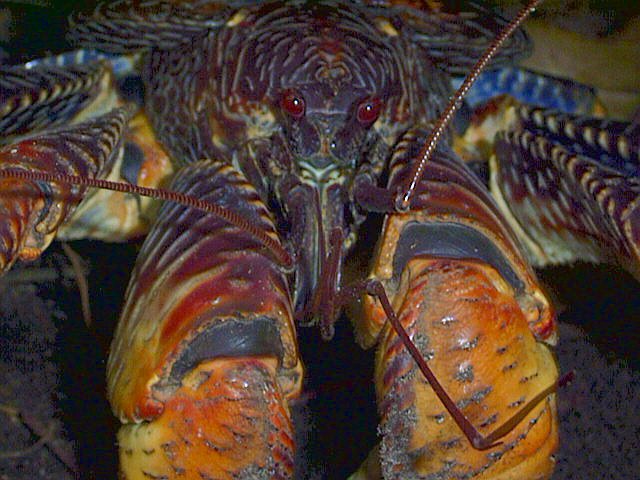
And a human for scale
"The coconut crab, Birgus latro, is a species of terrestrial hermit crab, also known as the robber crab or palm thief. It is the largest land-living arthropod in the world, and is probably at the upper size limit for terrestrial animals with exoskeletons in recent Earth atmosphere, with a weight of up to 4.1 kg (9.0 lb). It can grow to up to 1 m (3 ft 3 in) in length from leg to leg. It is found on islands across the Indian Ocean and parts of the Pacific Ocean as far east as the Gambier Islands mirroring the distribution of the coconut palm; it has been extirpated from most areas with a significant human population, including mainland Australia and Madagascar.
The coconut crab is the only species of the genus Birgus, and is related to the terrestrial hermit crabs of the genus Coenobita. It shows a number of adaptations to life on land. Like hermit crabs, juvenile coconut crabs use empty gastropod shells for protection, but the adults develop a tough exoskeleton on their abdomen and stop carrying a shell. Coconut crabs have organs known as "branchiostegal lungs", which are used instead of the vestigial gills for breathing. They cannot swim, and will drown if immersed in water for long. They have developed an acute sense of smell, which has developed convergently with that of insects, and which they use to find potential food sources. Mating occurs on dry land, but the females migrate to the sea to release their fertilized eggs as they hatch. The larvae are planktonic for 3–4 weeks, before settling to the sea floor and entering a gastropod shell. Sexual maturity is reached after about 5 years, and the total lifespan may be over 60 years.
Adult coconut crabs feed on fruits, nuts, seeds, and the pith of fallen trees, but will eat carrion and other organic matter opportunistically. The species is popularly associated with the coconut, and has been widely reported to climb trees to pick coconuts, which it then opens to eat the insides. While coconut crabs can climb trees, and can eventually open a coconut collectively; coconuts are not a significant part of their diet. Coconut crabs are hunted wherever they come into contact with people, and are subject to legal protection in some areas. In the absence of precise information, the IUCN lists the species as Data Deficient."
Tuesday, July 7, 2015
Have an Apology
Happy Tuesday!
Sorry for not posting a cute animal this morning. Here's a cute cat to make up for it:

Sorry for not posting a cute animal this morning. Here's a cute cat to make up for it:

My Adventures with the No Carb Diet
So, I'm on the No Carb Diet. Well, as "no" carb as I can get it. That means that I'm eating proteins, fat and a few low carb veggies, so my current diet consists of ham, chicken, beef jerky, green peppers, mushrooms, onions, hard boiled eggs, cheese, and nuts. Logan will be getting me a chard, kale and spinach salad mix on Thursday.
This isn't that much different from the diet I adopted about a month ago, which included fruits, milk, other veggies and some bread. I've been losing weight on this diet without much portion control and no loss in energy. It's also really fun, 'cause Logan gets me grapes with the seeds still in them, and I have as much fun spitting grape seeds and munching provolone as I do chowing down on seedy watermelon. I love every little reminder of my connection with this earth....
I got on the new diet for health reasons (I got tired of gaining weight, feeling tired and never being full), and I'm on the No Carb Diet for other health reasons.
The funniest thing about this diet is that it is the exact opposite of my college diet, which was mostly carbs. A diet high in carbs makes me feel sluggish and bloated, my blood sugar spikes and drops, I eat till I get sick on sugar without ever feeling really full and my body never feels satisfied.
On the new diet of all the foods I actually like, especially the fruits and veggies, I feel fuller sooner, my blood sugar is much steadier and I actually get to the point where I don't feel the urge to shove food into my mouth the instant it presents itself (which is a side affect of the insidious corn syrup). I started losing weight without any lifestyle change and I enjoy my food a lot more.
This No Carb Diet, though, man. I started it Sunday afternoon, so I've only been on it for about two days. But even in that time period, I've noticed how different it is. For one thing, I'm constantly thinking about carbacious foods (no, that's not actually a word), like my grapes, and apples, and carrots, and beans, and rice and nice, hot fresh bread.... and crackers. MmmMMMmmmm. And then there is the fact that I finally learned to eat only after I got hungry, but can't do that on this diet. I've eaten till my stomach started to hurt and my blood sugar didn't change. Turns out, it takes longer to digest meat and tough veggies, so blood sugar doesn't change for a while after eating (who would'a guessed?). So, I'm going to have to learn to eat before I get hungry. The other thing is that I feel lighter, emptier, and not bloated, and my energy levels are stable.
The best experiment happened today, though, when I cheated on my diet and ate a piece of cake. One of my coworkers had a birthday today, and my not-boss got her a chocolate cake. I decided to get a little piece, carry it to my desk, and throw it away when no one was looking. Hoorah! for upholding social expectations without breaking the rules of my diet!!
Heh. That was a great excuse to get carbs! I just had to taste the chocolate icing, and it was actually good! And then I bit the cake... and it was actually good, too (I don't normally enjoy cake, much less store-bought cake). Aaaaaaaand, I'd hadn't had sugar in so long!! (Since Saturday, as a matter of fact.)
Oh, but the effects of that compromise were almost immediate. It was a fantastic progression of misery. First, it tasted really good (not amazing, 'cause it was still cake), then my blood sugar shot straight up and something that claimed to be an internal organ started to complain. Then I got bloated, felt lethargic and antsy at the same time, and then alternated between wanting to cry that I had to start my diet over (I have to go a straight seven days), wanting to laugh that I been handed something I may have been tempted to steal, and wanting to cry because of my pitiable lack of self-control. Then I just felt sick.
So, the diet started over this evening with ham and cooked green peppers, onions and mushrooms.
I was promised I could have spaghetti, meatballs and garlic toast for my first non-No Carb Diet meal. After today's experience, I may just settle down with a glass of milk.
This isn't that much different from the diet I adopted about a month ago, which included fruits, milk, other veggies and some bread. I've been losing weight on this diet without much portion control and no loss in energy. It's also really fun, 'cause Logan gets me grapes with the seeds still in them, and I have as much fun spitting grape seeds and munching provolone as I do chowing down on seedy watermelon. I love every little reminder of my connection with this earth....
I got on the new diet for health reasons (I got tired of gaining weight, feeling tired and never being full), and I'm on the No Carb Diet for other health reasons.
The funniest thing about this diet is that it is the exact opposite of my college diet, which was mostly carbs. A diet high in carbs makes me feel sluggish and bloated, my blood sugar spikes and drops, I eat till I get sick on sugar without ever feeling really full and my body never feels satisfied.
On the new diet of all the foods I actually like, especially the fruits and veggies, I feel fuller sooner, my blood sugar is much steadier and I actually get to the point where I don't feel the urge to shove food into my mouth the instant it presents itself (which is a side affect of the insidious corn syrup). I started losing weight without any lifestyle change and I enjoy my food a lot more.
This No Carb Diet, though, man. I started it Sunday afternoon, so I've only been on it for about two days. But even in that time period, I've noticed how different it is. For one thing, I'm constantly thinking about carbacious foods (no, that's not actually a word), like my grapes, and apples, and carrots, and beans, and rice and nice, hot fresh bread.... and crackers. MmmMMMmmmm. And then there is the fact that I finally learned to eat only after I got hungry, but can't do that on this diet. I've eaten till my stomach started to hurt and my blood sugar didn't change. Turns out, it takes longer to digest meat and tough veggies, so blood sugar doesn't change for a while after eating (who would'a guessed?). So, I'm going to have to learn to eat before I get hungry. The other thing is that I feel lighter, emptier, and not bloated, and my energy levels are stable.
The best experiment happened today, though, when I cheated on my diet and ate a piece of cake. One of my coworkers had a birthday today, and my not-boss got her a chocolate cake. I decided to get a little piece, carry it to my desk, and throw it away when no one was looking. Hoorah! for upholding social expectations without breaking the rules of my diet!!
Heh. That was a great excuse to get carbs! I just had to taste the chocolate icing, and it was actually good! And then I bit the cake... and it was actually good, too (I don't normally enjoy cake, much less store-bought cake). Aaaaaaaand, I'd hadn't had sugar in so long!! (Since Saturday, as a matter of fact.)
Oh, but the effects of that compromise were almost immediate. It was a fantastic progression of misery. First, it tasted really good (not amazing, 'cause it was still cake), then my blood sugar shot straight up and something that claimed to be an internal organ started to complain. Then I got bloated, felt lethargic and antsy at the same time, and then alternated between wanting to cry that I had to start my diet over (I have to go a straight seven days), wanting to laugh that I been handed something I may have been tempted to steal, and wanting to cry because of my pitiable lack of self-control. Then I just felt sick.
So, the diet started over this evening with ham and cooked green peppers, onions and mushrooms.
I was promised I could have spaghetti, meatballs and garlic toast for my first non-No Carb Diet meal. After today's experience, I may just settle down with a glass of milk.
Monday, July 6, 2015
Christian Preachers Brutally Beaten at Gay Pride Festival
http://radio.foxnews.com/toddstarnes/top-stories/christian-preachers-brutally-beaten-at-gay-pride-festival.html
"Two street preachers were brutally beaten — punched and kicked — by a crowd at a gay pride festival in Seattle and the entire melee was captured on video.
The preachers were holding signs reading “Repent or Else” and “Jesus Saves From Sin.” The video shows a group of people initially screaming and threatening the men during Pridefest at the Seattle Space Needle.
Television station KOMO reported that some of the attackers belonged to a group called NOH8
A group of women tried to steal their signs but were unsuccessful. The video then shows a group of men grabbing onto one of the preacher’s signs and dragging him to the ground. At some point he was punched in the back of the head a number of times while others can be seen kicking the man.
Another preacher was sucker punched in the back of the head."
In case you were wondering if this ever happens......
LaVoice Update - Susan
Hello, Cool People.
Since I got Friday off work, Logan, Andrew and I went to Chattanooga to visit my family. We left around 7:30 pm on Thursday and arrived around 1:30/2 am.
We slept in on Friday, went for a walk on Missionary Ridge in the rain with Mom, Amy (older sister) and Grace (youngest sister), introduced Grace to Steven Universe and ate tasty food. Grace introduced us to a book called The Little Prince, and I greatly recommend reading it if you can.
Mom packed that evening for her trip to CO to visit Sarah (younger sister who is having a baby soon!) and we wished her off at 5 am Saturday morning.
Logan and I stayed up for a minute to talk, then went back to bed for a couple of hours. We got up around 10 am to get ready to go to my Grandparents Wrights in Scottsboro, AL, to visit and grill hot dogs. The day was absolutely beautiful; the sky was full of clouds, there was an almost constant breeze and everything was brilliant green from all the rain they've been getting. After our late lunch and homemade ice cream, Logan, Andrew, Grace and I went out into the woods to visit the massive waterfall. I saw a caterpillar and some cool mushrooms, too.
Then we packed up and drove the two hours home, and were then too tired to think straight. So we sat around while Amy made more tasty food (fried squash, corn on the cob and hamburger patties) and went to bed around 11 pm.
Sunday started out as slowly as Saturday had ended. Logan and I ended up going to my Dad's church, which was really cool. Then we went home, ate lunch (spaghetti, prepared by older brother Daniel) packed up and left for Memphis.
We got home around 8 pm, unpacked, showered and went to bed. Our cat was very glad to see us and couldn't decide if he wanted to go outside and explore or stay inside and welcome us home.
Have a Banded Mongoose
Happy Monday!

"The banded mongoose (Mungos mungo) is a mongoose commonly found in the central and eastern parts of Africa. It lives in savannas, open forests and grasslands and feeds primarily on beetles and millipedes. Mongooses use various types of dens for shelter including termite mounds. While most mongoose species live solitary lives, the banded mongoose live in colonies with a complex social structure.
They will also live in rock shelters, thickets, gullies, and warrens under bushes. Mongooses prefer multi-entranced termitaria with open thicket, averaging 4 m from the nearest shelter, located in semi-closed woodland. In contrast to the den of the dwarf mongoose, banded mongoose dens are less dependent on vegetation cover and have more entrances. Banded mongooses live in larger groups than dwarf mongooses and this more entrances means more members have access to the den and ventilation. The development of agriculture in the continent has had a positive influence on the number of banded mongooses. The crops of the farmland serve as an extra food source.
Banded mongoose feed primarily on insects, myriapods, small reptiles, and birds. Millipedes and beetles made of most of their diet, but they also commonly eat ants, crickets, termites, grasshoppers, caterpillars and earwigs. Other prey items of the mongoose includes frogs, lizards, small snakes, ground bird and the eggs of both birds and reptiles. On some occasions, mongooses will drink water from rain pools and lake shores.
Banded mongoose forage in groups but each member searches for food alone. They forage in the morning for several hours and then rest in the shade. They will usually forage again in the late afternoon. Mongooses use their sense of smell to locate their prey and dig them out with their long claws, both in holes in the ground and holes in trees. Mongoose will also frequent near the dung of large herbivores since they attract beetles. Low grunts are produced every few seconds for communication. Mongoose also feed individually and are not cooperative feeders. When hunting prey that secrete toxins, mongooses will roll them on the ground. Durable prey is thrown on hard surfaces.
Banded mongooses live in mixed-sex groups of 7–40 individuals (average around 20). Groups sleep together at night in underground dens, often abandoned termite mounds, and change dens frequently (every 2–3 days). When no refuge is available and hard-pressed by predators such as wild dogs, the group will form a compact arrangement in which they lie on each other with heads facing outwards and upwards.
There is generally no strict hierarchy in mongoose groups and aggression is low. Sometimes, mongoose may squabble over a food. However, typically, the one who claims the food first wins. Most aggression and hierarchical behavior occurs between males when females are in oestrus. Female are usually not aggressive but do live in hierarchies based on age. The older females have earlier estrous periods and have larger litters. When groups get too large, some females are forced out of the group by either older females or males. These females may form new groups with subordinate males.
Relations between groups are highly aggressive and mongooses are sometimes killed and injured during intergroup encounters. Nevertheless, breeding females will often mate with males from a rival groups during fights. Mongooses establish their territories with scent markings that may also serve as communication between those in the same group."
~Wikipedia.org

"The banded mongoose (Mungos mungo) is a mongoose commonly found in the central and eastern parts of Africa. It lives in savannas, open forests and grasslands and feeds primarily on beetles and millipedes. Mongooses use various types of dens for shelter including termite mounds. While most mongoose species live solitary lives, the banded mongoose live in colonies with a complex social structure.
They will also live in rock shelters, thickets, gullies, and warrens under bushes. Mongooses prefer multi-entranced termitaria with open thicket, averaging 4 m from the nearest shelter, located in semi-closed woodland. In contrast to the den of the dwarf mongoose, banded mongoose dens are less dependent on vegetation cover and have more entrances. Banded mongooses live in larger groups than dwarf mongooses and this more entrances means more members have access to the den and ventilation. The development of agriculture in the continent has had a positive influence on the number of banded mongooses. The crops of the farmland serve as an extra food source.
Banded mongoose feed primarily on insects, myriapods, small reptiles, and birds. Millipedes and beetles made of most of their diet, but they also commonly eat ants, crickets, termites, grasshoppers, caterpillars and earwigs. Other prey items of the mongoose includes frogs, lizards, small snakes, ground bird and the eggs of both birds and reptiles. On some occasions, mongooses will drink water from rain pools and lake shores.
Banded mongoose forage in groups but each member searches for food alone. They forage in the morning for several hours and then rest in the shade. They will usually forage again in the late afternoon. Mongooses use their sense of smell to locate their prey and dig them out with their long claws, both in holes in the ground and holes in trees. Mongoose will also frequent near the dung of large herbivores since they attract beetles. Low grunts are produced every few seconds for communication. Mongoose also feed individually and are not cooperative feeders. When hunting prey that secrete toxins, mongooses will roll them on the ground. Durable prey is thrown on hard surfaces.
Banded mongooses live in mixed-sex groups of 7–40 individuals (average around 20). Groups sleep together at night in underground dens, often abandoned termite mounds, and change dens frequently (every 2–3 days). When no refuge is available and hard-pressed by predators such as wild dogs, the group will form a compact arrangement in which they lie on each other with heads facing outwards and upwards.
There is generally no strict hierarchy in mongoose groups and aggression is low. Sometimes, mongoose may squabble over a food. However, typically, the one who claims the food first wins. Most aggression and hierarchical behavior occurs between males when females are in oestrus. Female are usually not aggressive but do live in hierarchies based on age. The older females have earlier estrous periods and have larger litters. When groups get too large, some females are forced out of the group by either older females or males. These females may form new groups with subordinate males.
Relations between groups are highly aggressive and mongooses are sometimes killed and injured during intergroup encounters. Nevertheless, breeding females will often mate with males from a rival groups during fights. Mongooses establish their territories with scent markings that may also serve as communication between those in the same group."
~Wikipedia.org
Thursday, July 2, 2015
Have a Red Panda
Happy Thursday!

"The red panda (Ailurus fulgens), also called lesser panda, red bear-cat and red cat-bear, is a small arboreal mammal native to the eastern Himalayas and south-western China that has been classified as vulnerable by IUCN as its wild population is estimated at less than 10,000 mature individuals. The population continues to decline and is threatened by habitat loss and fragmentation, poaching, and inbreeding depression, although red pandas are protected by national laws in their range countries.
The red panda is slightly larger than a domestic cat. It has reddish-brown fur, a long, shaggy tail, and a waddling gait due to its shorter front legs. It feeds mainly on bamboo, but is omnivorous and also eats eggs, birds, insects, and small mammals. It is a solitary animal, mainly active from dusk to dawn, and is largely sedentary during the day.
The red panda is the only living species of the genus Ailurus and the family Ailuridae. ...which along with the weasel, raccoon and skunk families is part of the superfamily Musteloidea. Two subspecies are recognized. It is not closely related to the giant panda.
The red panda is territorial; it is solitary except during mating season. The species is generally quiet except for some twittering, tweeting, and whistling communication sounds. It has been reported to be both nocturnal and crepuscular, sleeping on tree branches or in tree hollows during the day and increasing its activity in the late afternoon and early evening hours. It sleeps stretched out on a branch with legs dangling when it is hot, and curled up with its tail over the face when it is cold. This panda is very heat sensitive, with an optimal “well-being” temperature between 17 and 25 °C (63 and 77 °F), and cannot tolerate temperatures over 25 °C (77 °F).
Red panda standing
Shortly after waking, red pandas clean their fur like a cat, licking their front paws and then rubbing their backs, stomachs and sides. They also rub their backs and bellies along the sides of trees or rocks. Then they patrol their territories, marking with urine and a weak musk-smelling secretion from their anal glands. They search for food running along the ground or through the trees. Red pandas may alternately use their forepaws to bring food to their mouths or place food directly into their mouths.
Predators of the red panda include the snow leopard, martens (Mustelidae), and humans. If they feel threatened or sense danger, they may try to escape by climbing a rock column or tree. If they can no longer flee, they stand on their hind legs to make themselves appear larger and use the sharp claws on their front paws to defend themselves.
Red pandas are excellent climbers, and forage largely in trees. They eat mostly bamboo, and may eat small mammals, birds, eggs, flowers and berries. In captivity, they were observed to eat birds, flowers, maple and mulberry leaves, and bark and fruits of maple, beech and mulberry.
Like the giant panda, they cannot digest cellulose, so they must consume a large volume of bamboo to survive. Their diets consist of about two-thirds bamboo, but they also eat mushrooms, roots, acorns, lichen and grasses. Occasionally, they supplement their diets with fish and insects."
~Wikipedia.org

"The red panda (Ailurus fulgens), also called lesser panda, red bear-cat and red cat-bear, is a small arboreal mammal native to the eastern Himalayas and south-western China that has been classified as vulnerable by IUCN as its wild population is estimated at less than 10,000 mature individuals. The population continues to decline and is threatened by habitat loss and fragmentation, poaching, and inbreeding depression, although red pandas are protected by national laws in their range countries.
The red panda is slightly larger than a domestic cat. It has reddish-brown fur, a long, shaggy tail, and a waddling gait due to its shorter front legs. It feeds mainly on bamboo, but is omnivorous and also eats eggs, birds, insects, and small mammals. It is a solitary animal, mainly active from dusk to dawn, and is largely sedentary during the day.
The red panda is the only living species of the genus Ailurus and the family Ailuridae. ...which along with the weasel, raccoon and skunk families is part of the superfamily Musteloidea. Two subspecies are recognized. It is not closely related to the giant panda.
The red panda is territorial; it is solitary except during mating season. The species is generally quiet except for some twittering, tweeting, and whistling communication sounds. It has been reported to be both nocturnal and crepuscular, sleeping on tree branches or in tree hollows during the day and increasing its activity in the late afternoon and early evening hours. It sleeps stretched out on a branch with legs dangling when it is hot, and curled up with its tail over the face when it is cold. This panda is very heat sensitive, with an optimal “well-being” temperature between 17 and 25 °C (63 and 77 °F), and cannot tolerate temperatures over 25 °C (77 °F).
Red panda standing
Shortly after waking, red pandas clean their fur like a cat, licking their front paws and then rubbing their backs, stomachs and sides. They also rub their backs and bellies along the sides of trees or rocks. Then they patrol their territories, marking with urine and a weak musk-smelling secretion from their anal glands. They search for food running along the ground or through the trees. Red pandas may alternately use their forepaws to bring food to their mouths or place food directly into their mouths.
Predators of the red panda include the snow leopard, martens (Mustelidae), and humans. If they feel threatened or sense danger, they may try to escape by climbing a rock column or tree. If they can no longer flee, they stand on their hind legs to make themselves appear larger and use the sharp claws on their front paws to defend themselves.
Red pandas are excellent climbers, and forage largely in trees. They eat mostly bamboo, and may eat small mammals, birds, eggs, flowers and berries. In captivity, they were observed to eat birds, flowers, maple and mulberry leaves, and bark and fruits of maple, beech and mulberry.
Like the giant panda, they cannot digest cellulose, so they must consume a large volume of bamboo to survive. Their diets consist of about two-thirds bamboo, but they also eat mushrooms, roots, acorns, lichen and grasses. Occasionally, they supplement their diets with fish and insects."
~Wikipedia.org
Wednesday, July 1, 2015
Have a Giant Darner Dragonfly
Happy Wednesday!

Adult males vigorously defend territories near water; these areas provide suitable habitat for the larvae to develop, and for females to lay their eggs. Swarms of feeding adults aggregate to prey on swarming prey such as emerging flying ants or termites.
Dragonflies as a group occupy a considerable variety of habitats, but many species, and some families, have their own specific environmental requirements. Some species prefer flowing waters while others prefer standing water. For example, the Gomphidae (clubtails) live in running water, the Libellulidae (skimmers) in still water. ... Vegetation and its characteristics including submerged, floating, emergent, or waterside are also important. Adults may require emergent or waterside plants to use as perches; others may need specific submerged or floating plants in which to lay eggs. Requirements may be highly specific, as in Aeshna viridis (green hawker) which lives in swamps with the water-soldier, Stratiotes aloides. The chemistry of the water, including its trophic status (degree of enrichment with nutrients) and pH can also affect its use by dragonflies. Most species need moderate conditions, not too eutrophic, not too acid; a few species such as Sympetrum danae (black darter) and Libellula quadrimaculata (four-spotted chaser) prefer acidic waters such as peat bogs, while others such as Libellula fulva (scarce chaser) need slow-moving, eutrophic waters with reeds or similar waterside plants.
Dragonflies are hemimetabolous insects; they do not have a pupal stage and undergo an incomplete metamorphosis with a series of nymphal stages from which the adult emerges."
~Wikipedia.org
Just a side note... I've had the unfortunate experience of watching a dragonfly die. The light in its eyes went out.

This giant darner is cleaning his face.
These dragonflies are the largest in the US.
"A dragonfly is an insect belonging to the order Odonata, suborder Anisoptera (from Greek ανισος anisos "uneven" + πτερος pteros, "wings", because the hindwing is broader than the forewing). Adult dragonflies are characterized by large multifaceted eyes, two pairs of strong transparent wings, sometimes with coloured patches, and an elongated body.
Dragonflies and damselflies are predatory both in the aquatic nymphal and adult stages. Nymphs feed on a range of freshwater invertebrates and larger ones can prey on tadpoles and small fish. Adults capture insect prey in the air, making use of their acute vision and highly controlled flight. The mating system of dragonflies is complex and are among the few insect groups that have a system of indirect sperm transfer along with sperm storage, delayed fertilization and sperm competition.
Adult males vigorously defend territories near water; these areas provide suitable habitat for the larvae to develop, and for females to lay their eggs. Swarms of feeding adults aggregate to prey on swarming prey such as emerging flying ants or termites.
Dragonflies as a group occupy a considerable variety of habitats, but many species, and some families, have their own specific environmental requirements. Some species prefer flowing waters while others prefer standing water. For example, the Gomphidae (clubtails) live in running water, the Libellulidae (skimmers) in still water. ... Vegetation and its characteristics including submerged, floating, emergent, or waterside are also important. Adults may require emergent or waterside plants to use as perches; others may need specific submerged or floating plants in which to lay eggs. Requirements may be highly specific, as in Aeshna viridis (green hawker) which lives in swamps with the water-soldier, Stratiotes aloides. The chemistry of the water, including its trophic status (degree of enrichment with nutrients) and pH can also affect its use by dragonflies. Most species need moderate conditions, not too eutrophic, not too acid; a few species such as Sympetrum danae (black darter) and Libellula quadrimaculata (four-spotted chaser) prefer acidic waters such as peat bogs, while others such as Libellula fulva (scarce chaser) need slow-moving, eutrophic waters with reeds or similar waterside plants.
Dragonflies are hemimetabolous insects; they do not have a pupal stage and undergo an incomplete metamorphosis with a series of nymphal stages from which the adult emerges."
~Wikipedia.org
Just a side note... I've had the unfortunate experience of watching a dragonfly die. The light in its eyes went out.
Tuesday, June 30, 2015
Have a Black and White Colobus Monkey

"Black-and-white colobuses (or colobi) are Old World monkeys of the genus Colobus, native to Africa. They are closely related to the brown colobus monkeys of genus Piliocolobus. The word "colobus" comes from Greek κολοβός kolobós ("docked"), and is so named because in this genus, the thumb is a stump. Colobuses are herbivorous, eating leaves, fruit, flowers, and twigs. Their habitats include primary and secondary forests, riverine forests, and wooded grasslands; they are found more in higher-density logged forests than in other primary forests. Their ruminant-like digestive systems have enabled these leaf-eaters to occupy niches that are inaccessible to other primates.
Colobuses live in territorial groups of about nine individuals, based upon a single male with a number of females and their offspring. Newborn colobuses are completely white. Cases of allomothering are documented, which means members of the troop other than the infant's biological mother care for it.
Colobuses are important for seed dispersal through their sloppy eating habits, as well as through their digestive systems. They are prey for many forest predators, and are threatened by hunting for the bushmeat trade, logging, and habitat destruction.
There are five species of this monkey, with at least eight subspecies..."
~Wikipedia.org
Monday, June 29, 2015
Entomophagy!!! And Why It is Good
This, to me, is a very powerful message. I like stuff like this because it uses pictures to communicate, not just words.
The fact is, this is true. I don't know the numbers on how fast entomophagy (isn't that a cool word?) is declining, but this follows the same pattern as western missionaries: walk in, make everyone dress and behave like westerners, approve of their existence, walk out and leave them to starve on a culture that is incompatible with their environment.
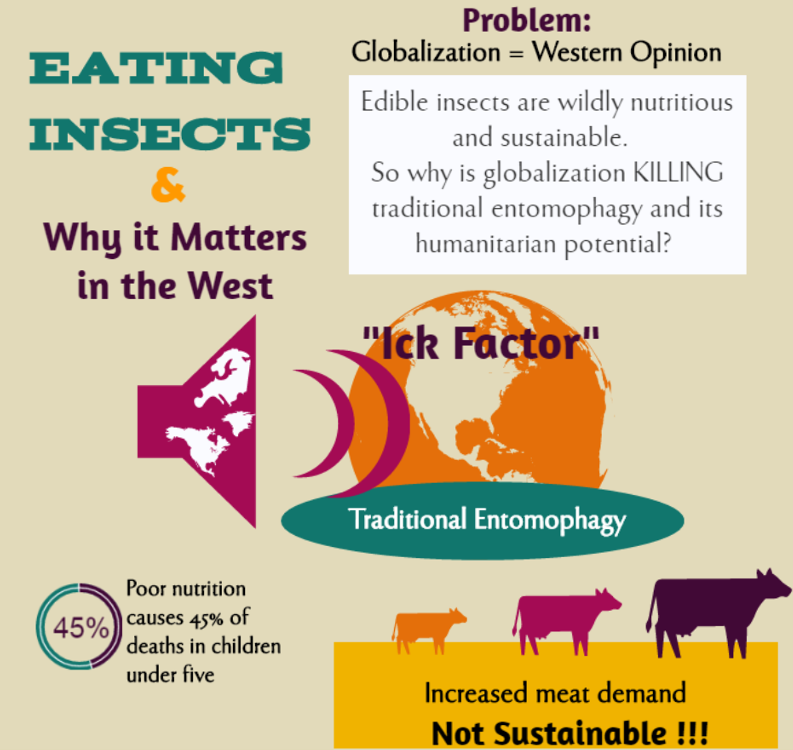
So what's being said here? Western philosophies about our environment and how we should interact with it is causing people to stop eating foods (that are actually foods!) and start living in a way that is unsustainable. We've known for years that America's appetite is sinfully excessive, and that if the rest of the world tried to reach our level of consumption we'd self-destruct faster than an agent's mission instructions. (I know that America is not the only member of the "West," but it is the only one I know enough about to have this conversation.)
At one point, it would have taken six planet earths to feed, clothe, house, and accessorize every nation to the level that America had attained. And since then, both America's consumption and the global population have increased significantly, increasing the gap between what America says is possible and what is actually possible.
There we go, telling lies again....
And yes, insects are both food and good food. As is algae. And the sooner the West recognizes that we can't escape the fall by being speciesists, the better off everyone will be.
If Life Were A Chess Game, I'd Be A Pawn
Below is a thing I wrote in August of 2010, with minor edits.

"If life were a Chess game, I'd be a pawn.
Nobody really likes pawns. They are the expendable crewmen of the game - sent out to "feel" the enemy, positioned so as to be captured instead of a more valuable piece, and if captured, no one misses them. If the pawn manages to capture an enemy piece, it is usually another pawn. And the enemy usually sacrificed that pawn on purpose, to buy time or force the opponent into position. If the pawn captures a piece of greater status, it is not cause for joy or praise. The player who lost their piece is shamed for laziness or neglect, and the player who captured it is nervous that he may have been set up, and feels shame for his enemy for such a shortsighted loss.
The pawns is of less value than the other pieces in the army for good reasons. They are limited in their direction, distance, and attack. They are usually the first to be captured, and there is no effort made to regain them.
The pawn has one objective: get across the field. It is a pleasant surprise for the pawn to capture any piece, and a greater one for it to actually make it across the field uncaptured itself.
Should the pawn reach the enemy's home base, it gains one thing: imprisonment. It is swapped for a more valuable, previously captured, piece.
The pawn's entire existence is self-sacrifice. It is meant to be captured, either to buy time, allow another piece to move or protect a higher ranking piece from being captured.
I am a Pawn. Though I sometimes wish for the pomp of the Bishop, or the glory of the Knight, or the strength of the Tower, or even sometimes, the power of the Queen, I wish to be other than myself for only a moment. I was made to be a Pawn, and it is good.
To be the first one on the battle field.....
To stand shoulder-to-shoulder with my fellow Pawns, my countrymen behind me and my foe before me....
To be literally incapable of moving backwards, while limited in distance and attack.......
To be one of the first to make a move, one of the first to engage in battle......
To have one goal, one focus: make it past all the enemy, surrender, and trade freedom for imprisonment, that the king may have better odds of survival......
That takes courage. It takes a will of iron. It takes an unshakable drive to do what one was designed to do.
That is an awesome feeling. And while I may have my moments of envy, I am a Pawn, and I love it.

"If life were a Chess game, I'd be a pawn.
Nobody really likes pawns. They are the expendable crewmen of the game - sent out to "feel" the enemy, positioned so as to be captured instead of a more valuable piece, and if captured, no one misses them. If the pawn manages to capture an enemy piece, it is usually another pawn. And the enemy usually sacrificed that pawn on purpose, to buy time or force the opponent into position. If the pawn captures a piece of greater status, it is not cause for joy or praise. The player who lost their piece is shamed for laziness or neglect, and the player who captured it is nervous that he may have been set up, and feels shame for his enemy for such a shortsighted loss.
The pawns is of less value than the other pieces in the army for good reasons. They are limited in their direction, distance, and attack. They are usually the first to be captured, and there is no effort made to regain them.
The pawn has one objective: get across the field. It is a pleasant surprise for the pawn to capture any piece, and a greater one for it to actually make it across the field uncaptured itself.
Should the pawn reach the enemy's home base, it gains one thing: imprisonment. It is swapped for a more valuable, previously captured, piece.
The pawn's entire existence is self-sacrifice. It is meant to be captured, either to buy time, allow another piece to move or protect a higher ranking piece from being captured.
I am a Pawn. Though I sometimes wish for the pomp of the Bishop, or the glory of the Knight, or the strength of the Tower, or even sometimes, the power of the Queen, I wish to be other than myself for only a moment. I was made to be a Pawn, and it is good.
To be the first one on the battle field.....
To stand shoulder-to-shoulder with my fellow Pawns, my countrymen behind me and my foe before me....
To be literally incapable of moving backwards, while limited in distance and attack.......
To be one of the first to make a move, one of the first to engage in battle......
To have one goal, one focus: make it past all the enemy, surrender, and trade freedom for imprisonment, that the king may have better odds of survival......
That takes courage. It takes a will of iron. It takes an unshakable drive to do what one was designed to do.
That is an awesome feeling. And while I may have my moments of envy, I am a Pawn, and I love it.
Have a Soldier Fly
Happy Monday!

"Hermetia illucens, the black soldier fly, is a common and widespread fly of the family Stratiomyidae, whose larvae are common detritivores in compost heaps. Larvae are also sometimes found in association with carrion, and have significant potential for use in forensic entomology.
Black soldier fly larvae (BSFL), also known as "phoenix worms", may be used in manure management, for house fly control and for the bioconversion of organic waste material. Mature larvae and prepupae raised in manure management and waste bioconversion operations may also be used to supplement animal feeds.
Larvae are sold as feeders for owners of herptiles [(reptiles and amphibians)] and tropical fish, or as composting grubs. They store high levels of calcium for future pupation which is beneficial to herptiles.
Black soldier fly eggs take approximately four days to hatch and are typically deposited in crevices or on surfaces above or adjacent to decaying matter such as manure or compost. The larvae range in size from 1⁄8–3⁄4 inch (3–19 mm). ...
The adult fly, which measures about 16 mm (5/8 inch), has a life span of 5 to 8 days. It is a mimic, very close in size, color, and appearance to the organ pipe mud dauber wasp and its relatives. The mimicry of this particular kind of wasp is especially enhanced in that the fly's antennae are elongated and wasp-like, the fly's hind tarsi are pale, as are the wasp's, and the fly has two small transparent "windows" in the basal abdominal segments that make the fly appear to have a narrow "wasp waist". The adult soldier fly has no functioning mouthparts; it spends its time searching for mates and reproducing.
[The larvae] prevent houseflies and blowflies from laying eggs in the material inhabited by black soldier fly larvae, [and the adults] are usually not a pest. They are not attracted to human habitation or foods. As a detritivore and coprovore, the egg-bearing females are attracted to rotting food or manure.
Black soldier flies do not fly around as much as houseflies. They are very easy to catch and relocate when they get inside a house, as they do not avoid being picked up, they are sanitary, and they do not bite or sting. Their only defense seems to be hiding."
~Wikipedia.org
"Hermetia illucens, the black soldier fly, is a common and widespread fly of the family Stratiomyidae, whose larvae are common detritivores in compost heaps. Larvae are also sometimes found in association with carrion, and have significant potential for use in forensic entomology.
Black soldier fly larvae (BSFL), also known as "phoenix worms", may be used in manure management, for house fly control and for the bioconversion of organic waste material. Mature larvae and prepupae raised in manure management and waste bioconversion operations may also be used to supplement animal feeds.
Larvae are sold as feeders for owners of herptiles [(reptiles and amphibians)] and tropical fish, or as composting grubs. They store high levels of calcium for future pupation which is beneficial to herptiles.
Black soldier fly eggs take approximately four days to hatch and are typically deposited in crevices or on surfaces above or adjacent to decaying matter such as manure or compost. The larvae range in size from 1⁄8–3⁄4 inch (3–19 mm). ...
The adult fly, which measures about 16 mm (5/8 inch), has a life span of 5 to 8 days. It is a mimic, very close in size, color, and appearance to the organ pipe mud dauber wasp and its relatives. The mimicry of this particular kind of wasp is especially enhanced in that the fly's antennae are elongated and wasp-like, the fly's hind tarsi are pale, as are the wasp's, and the fly has two small transparent "windows" in the basal abdominal segments that make the fly appear to have a narrow "wasp waist". The adult soldier fly has no functioning mouthparts; it spends its time searching for mates and reproducing.
[The larvae] prevent houseflies and blowflies from laying eggs in the material inhabited by black soldier fly larvae, [and the adults] are usually not a pest. They are not attracted to human habitation or foods. As a detritivore and coprovore, the egg-bearing females are attracted to rotting food or manure.
Black soldier flies do not fly around as much as houseflies. They are very easy to catch and relocate when they get inside a house, as they do not avoid being picked up, they are sanitary, and they do not bite or sting. Their only defense seems to be hiding."
~Wikipedia.org
Friday, June 26, 2015
LaVoice Update - Susan
Depression has set in again. I didn't recognize it for some time, but after a mild emotional break down on Sunday, a lack of apatite all week and a migraine yesterday, the symptoms are now fairly clear. Since I'm currently reading the Harry Potter series (I'm on book 4), I now have an image for depression that works quite well- Dementors. Creatures that look like drowned, half-rotten corpses floating in torn black shrouds who feed on happy emotions and memories.
I was texting a friend just a few moments ago, and he told me that I've lost my spunk. I tried to remember something happy in order to conjure up the emotion necessary to respond to his text, but I couldn't. Every happy memory that started to come into focus blanked out, like someone clicking off the television screen. I thought about the dementors and suddenly realized that I'm depressed.
That made me smile. I've been depressed before, and I know that the worst lie a depressed person can believe, and also the easiest, is that this is how it will be forever. Nothing will change.
But I know better. It's changed before, and it will change again. For me, it will get better. At some point. But even if that Some Point is sixty years away, it will get better.
Now that I've named what is going on, I expect I'll handle it okay. I sat outside for a little bit yesterday, reading a book in the grass. I might just make an effort to do that again, since that is a prescribed remedy for depression. It's so funny to me how quickly I become covered in the smallest, strangest creatures if I sit still long enough. As annoying as their tininess can be on my sensitive skin, they are quite comforting. I didn't know that they existed until our lives intersected in that little patch of grass. I don't know their names, what they eat, how they reproduce or what eats them. But God knows. And He likes them. It is so comforting for me to look at the tiny shape moving across my page and remember how much God knows about me, and how much He likes me. A lot of people look at little moving creatures and either ignore them or squash them. But God sees them. And He sees me. It's wonderful.
I'm going to try to free up my Saturdays and see if I can't get more introvert time for myself. Most of my Saturdays this year have been spent playing DnD, which I will sorely miss, but it requires extroversion. Logan makes a wonderful DM, and the other players are hilarious role players. I'll miss the stories, as well. There's just something special about writing a fantasy story with friends who are so different from one's self....
Currently, all my personal projects are on hold. I reckon that if they were important enough, I'll remember them when my brain starts thinking about things other than work, and if they aren't important enough to remember than I've not wasted resources.
I have a fish! I had to get rid of the nine fish that I had late last year due to my inability to keep their water at a level pH. It made me sad. But now I have a beautiful blue rose fin beta. I may post pictures at some point, but he basically looks like this.
Logan and I are currently sleeping on a pile of blankets. We had to get rid of our mattress because it got so uncomfortable (it was, like, twenty years old when we inherited it after the wedding), and haven't had the money to get a new one. Don't tell Logan, but I really, really like sleeping on a pile of blankets and am avoiding getting a mattress for as long as possible. I've always been enamored with the gypsy/hippie lifestyle and I love having this little bit of it every day. If I could live in a covered wagon drawn by two little Welsh cobs, or a cabin strewn with embroidered pillows and hung all about with brightly colored tapestries, I totally would. Maybe at Some Point I'll live two hundred feet off the ground in a little tree house full of owls.
My studies of the OT law have dropped to a casual level, partly due to the fact that I'm trying to read through the Bible in one year and can't accomplish that if I never read anything outside of the books of law, and partly due to the fact that I rarely read anything serious anymore. My brain is so shot from the overwhelming under-stimulation of my current work level (they say it will get busier, but that doesn't change the bland color of my cubical walls), that it takes me an hour after I get home to get back to a place where I can be curious about anything, but then I only have an hour to eat food and it's time to get ready for bed. (Honestly, the 40 hour work week is murder to the human soul.) Those few hours between getting home from work and going to bed are the reason that most of my projects have dropped to the wayside.....
I think that's enough for now. Love y'all!
I was texting a friend just a few moments ago, and he told me that I've lost my spunk. I tried to remember something happy in order to conjure up the emotion necessary to respond to his text, but I couldn't. Every happy memory that started to come into focus blanked out, like someone clicking off the television screen. I thought about the dementors and suddenly realized that I'm depressed.
That made me smile. I've been depressed before, and I know that the worst lie a depressed person can believe, and also the easiest, is that this is how it will be forever. Nothing will change.
But I know better. It's changed before, and it will change again. For me, it will get better. At some point. But even if that Some Point is sixty years away, it will get better.
Now that I've named what is going on, I expect I'll handle it okay. I sat outside for a little bit yesterday, reading a book in the grass. I might just make an effort to do that again, since that is a prescribed remedy for depression. It's so funny to me how quickly I become covered in the smallest, strangest creatures if I sit still long enough. As annoying as their tininess can be on my sensitive skin, they are quite comforting. I didn't know that they existed until our lives intersected in that little patch of grass. I don't know their names, what they eat, how they reproduce or what eats them. But God knows. And He likes them. It is so comforting for me to look at the tiny shape moving across my page and remember how much God knows about me, and how much He likes me. A lot of people look at little moving creatures and either ignore them or squash them. But God sees them. And He sees me. It's wonderful.
I'm going to try to free up my Saturdays and see if I can't get more introvert time for myself. Most of my Saturdays this year have been spent playing DnD, which I will sorely miss, but it requires extroversion. Logan makes a wonderful DM, and the other players are hilarious role players. I'll miss the stories, as well. There's just something special about writing a fantasy story with friends who are so different from one's self....
Currently, all my personal projects are on hold. I reckon that if they were important enough, I'll remember them when my brain starts thinking about things other than work, and if they aren't important enough to remember than I've not wasted resources.
I have a fish! I had to get rid of the nine fish that I had late last year due to my inability to keep their water at a level pH. It made me sad. But now I have a beautiful blue rose fin beta. I may post pictures at some point, but he basically looks like this.

Logan and I are currently sleeping on a pile of blankets. We had to get rid of our mattress because it got so uncomfortable (it was, like, twenty years old when we inherited it after the wedding), and haven't had the money to get a new one. Don't tell Logan, but I really, really like sleeping on a pile of blankets and am avoiding getting a mattress for as long as possible. I've always been enamored with the gypsy/hippie lifestyle and I love having this little bit of it every day. If I could live in a covered wagon drawn by two little Welsh cobs, or a cabin strewn with embroidered pillows and hung all about with brightly colored tapestries, I totally would. Maybe at Some Point I'll live two hundred feet off the ground in a little tree house full of owls.
My studies of the OT law have dropped to a casual level, partly due to the fact that I'm trying to read through the Bible in one year and can't accomplish that if I never read anything outside of the books of law, and partly due to the fact that I rarely read anything serious anymore. My brain is so shot from the overwhelming under-stimulation of my current work level (they say it will get busier, but that doesn't change the bland color of my cubical walls), that it takes me an hour after I get home to get back to a place where I can be curious about anything, but then I only have an hour to eat food and it's time to get ready for bed. (Honestly, the 40 hour work week is murder to the human soul.) Those few hours between getting home from work and going to bed are the reason that most of my projects have dropped to the wayside.....
I think that's enough for now. Love y'all!
Have a Barn Owl
Happy Friday!

"Barn-owls (family Tytonidae) are one of the two families of owls, the other being the true owls, Strigidae. They are medium to large owls with large heads and characteristic heart-shaped faces. They have long, strong legs with powerful talons. They also differ from Strigidae in structural details relating in particular to the sternum and feet.
...The barn owls are a wide ranging family, although they are absent from northern North America, Saharan Africa and large areas of Asia. They live in a wide range of habitats from deserts to forests, and from temperate latitudes to the tropics. The majority of the 16 living species of barn owls are poorly known. Some, like the red owl, have barely been seen or studied since their discovery, in contrast to the common barn owl, which is one of the best known owl species in the world. However, some sub-species of the common barn owl possibly deserve to be separate species, but are very poorly known.
Five species of barn-owl are threatened... The barn-owls are mostly nocturnal, and generally non-migratory, living in pairs or singly.
The barn-owls' main characteristic is the heart-shaped facial disc, formed by stiff feathers which serve to amplify and locate the source of sounds when hunting. Further adaptations in the wing feathers eliminate sound caused by flying, aiding both the hearing of the owl listening for hidden prey and keeping the prey unaware of the owl. Barn-owls overall are darker on the back than the front, usually an orange-brown colour, the front being a paler version of the back or mottled, although there is considerable variation even amongst species. ..."
~Wikipedia.org

"Barn-owls (family Tytonidae) are one of the two families of owls, the other being the true owls, Strigidae. They are medium to large owls with large heads and characteristic heart-shaped faces. They have long, strong legs with powerful talons. They also differ from Strigidae in structural details relating in particular to the sternum and feet.
...The barn owls are a wide ranging family, although they are absent from northern North America, Saharan Africa and large areas of Asia. They live in a wide range of habitats from deserts to forests, and from temperate latitudes to the tropics. The majority of the 16 living species of barn owls are poorly known. Some, like the red owl, have barely been seen or studied since their discovery, in contrast to the common barn owl, which is one of the best known owl species in the world. However, some sub-species of the common barn owl possibly deserve to be separate species, but are very poorly known.
Five species of barn-owl are threatened... The barn-owls are mostly nocturnal, and generally non-migratory, living in pairs or singly.
The barn-owls' main characteristic is the heart-shaped facial disc, formed by stiff feathers which serve to amplify and locate the source of sounds when hunting. Further adaptations in the wing feathers eliminate sound caused by flying, aiding both the hearing of the owl listening for hidden prey and keeping the prey unaware of the owl. Barn-owls overall are darker on the back than the front, usually an orange-brown colour, the front being a paler version of the back or mottled, although there is considerable variation even amongst species. ..."
~Wikipedia.org
Thursday, June 25, 2015
How To Escape The Age Of Mass Delusion
"How To Escape The Age Of Mass Delusion"
"Mass delusion is an important tool of oppressors because they can’t survive free expression. That’s why the First Amendment’s a target."
http://thefederalist.com/2015/06/08/how-to-escape-the-age-of-mass-delusion/
This is one of the most insightful articles I've read in a long time. From explaining the toxicity of political correctness to why our culture seems to be in so much chaos, this article presents one of the master plans that is behind it all. The other and opposite master plan... well, you'll have to read your Bible to get that one :D
Please enjoy the quotes below, read the article and leave a comment!
"Political propaganda aims to mobilize the masses to move an agenda forward. ... Once the masses are mobilized to push for a cause, the propagandists’ goals can be put into law."
"American conservatives are by and large clueless about propaganda methods and tactics.... the Left has been employing social psychology and depth psychology on the masses for decades."
"...the power elites who now control the media, academia, and Hollywood seem to understand social psychology well enough to exploit it on a massive scale. ... Conditioning and nudging the masses into groupthink is a very old trick of all wannabe dictators."
"Family breakdown led to community breakdown, which we can see in the decline of trust in society. Ignorance was cultivated in the schools through political correctness and squashing free debate."
"Why would anyone want to build such a culture of coercion? In a word, power. “Equality” is not the reason for what is happening with such mobs. It is the pretext for what they are doing. Like all such deceptions, its sole purpose is as a vehicle to transfer power from individuals to an increasingly centralized state. The fuel, as usual, is the emotional blackmail of people of goodwill, the uses of mass mobilization to exploit that goodwill, then, finally, to render all such goodwill meaningless."
"Free expression is always the prime target of tyrants because it promotes logic, the search for truth, and friendship. America is exceptional precisely because it rejects the tyrants’ rule."
"So, in the end, freedom truly depends upon breaking down the walls of separation that tyranny builds. It means cultivating the art of friendship, boldly exercising our rights to free association and to communicate our thoughts to others. It means cultivating knowledge instead of cultivating ignorance.
After all, political correctness is primarily a tool for crushing people’s ability to have open conversations in friendship and mutual respect."
And, yes. Friendship IS magic ;)
"Mass delusion is an important tool of oppressors because they can’t survive free expression. That’s why the First Amendment’s a target."
http://thefederalist.com/2015/06/08/how-to-escape-the-age-of-mass-delusion/
This is one of the most insightful articles I've read in a long time. From explaining the toxicity of political correctness to why our culture seems to be in so much chaos, this article presents one of the master plans that is behind it all. The other and opposite master plan... well, you'll have to read your Bible to get that one :D
Please enjoy the quotes below, read the article and leave a comment!
"Political propaganda aims to mobilize the masses to move an agenda forward. ... Once the masses are mobilized to push for a cause, the propagandists’ goals can be put into law."
"American conservatives are by and large clueless about propaganda methods and tactics.... the Left has been employing social psychology and depth psychology on the masses for decades."
"...the power elites who now control the media, academia, and Hollywood seem to understand social psychology well enough to exploit it on a massive scale. ... Conditioning and nudging the masses into groupthink is a very old trick of all wannabe dictators."
"Family breakdown led to community breakdown, which we can see in the decline of trust in society. Ignorance was cultivated in the schools through political correctness and squashing free debate."
"Why would anyone want to build such a culture of coercion? In a word, power. “Equality” is not the reason for what is happening with such mobs. It is the pretext for what they are doing. Like all such deceptions, its sole purpose is as a vehicle to transfer power from individuals to an increasingly centralized state. The fuel, as usual, is the emotional blackmail of people of goodwill, the uses of mass mobilization to exploit that goodwill, then, finally, to render all such goodwill meaningless."
"Free expression is always the prime target of tyrants because it promotes logic, the search for truth, and friendship. America is exceptional precisely because it rejects the tyrants’ rule."
"So, in the end, freedom truly depends upon breaking down the walls of separation that tyranny builds. It means cultivating the art of friendship, boldly exercising our rights to free association and to communicate our thoughts to others. It means cultivating knowledge instead of cultivating ignorance.
After all, political correctness is primarily a tool for crushing people’s ability to have open conversations in friendship and mutual respect."
And, yes. Friendship IS magic ;)
Have a Dingo
Happy Thursday!

"The dingo (Canis lupus dingo) is a free-ranging dog found mainly in Australia. Its exact ancestry is debated, but dingoes are generally believed to be descended from semi-domesticated dogs from East or South Asia, which returned to a wild lifestyle when introduced to Australia. As such, it is currently classified as a subspecies of the grey wolf, Canis lupus. The Australian name has therefore sometimes been applied to similar dogs in South-East Asia, believed to be close relations. As free-ranging animals, they are not considered tame, although tame dingoes and dingo-dog hybrids have been bred.
The dingo's habitat ranges from deserts to grasslands and the edges of forests. Dingoes will normally make their dens in deserted rabbit holes and hollow logs close to an essential supply of water.
The dingo is the largest terrestrial predator in Australia, and plays an important role as an apex predator. However, the dingo is seen as a pest by livestock farmers due to attacks on animals. Conversely, their predation on rabbits, kangaroos and rats may be of benefit to graziers.
For many Australians, the dingo is a cultural icon. ... Dingoes have a prominent role in the culture of Aboriginal Australians as a feature of stories and ceremonies, and they are depicted on rock carvings and cave paintings.
Despite being an efficient hunter, it is listed as vulnerable to extinction. ... [Though they are very numerous, it is thought that the population is becoming genetically unstable.]
Dingoes tend to be nocturnal in warmer regions, but less so in cooler areas. Their main period of activity is around dusk and dawn. The periods of activity are short (often less than one hour) with short times of resting.
About 170 species (from insects to buffalo) have been identified as part of the dingo's diet. In general, livestock seems to make up only a small proportion of their diet.[6] In continent-wide examinations, 80% of the diet of wild dogs consisted of 10 species: red kangaroo, swamp wallaby, cattle, dusky rat, magpie goose, common brushtail possum, long-haired rat, agile wallaby, European rabbit and the common wombat. This narrow range of major prey indicates these wild dogs are rather specialised. ..."
~Wikipedia.org

"The dingo (Canis lupus dingo) is a free-ranging dog found mainly in Australia. Its exact ancestry is debated, but dingoes are generally believed to be descended from semi-domesticated dogs from East or South Asia, which returned to a wild lifestyle when introduced to Australia. As such, it is currently classified as a subspecies of the grey wolf, Canis lupus. The Australian name has therefore sometimes been applied to similar dogs in South-East Asia, believed to be close relations. As free-ranging animals, they are not considered tame, although tame dingoes and dingo-dog hybrids have been bred.
The dingo's habitat ranges from deserts to grasslands and the edges of forests. Dingoes will normally make their dens in deserted rabbit holes and hollow logs close to an essential supply of water.
The dingo is the largest terrestrial predator in Australia, and plays an important role as an apex predator. However, the dingo is seen as a pest by livestock farmers due to attacks on animals. Conversely, their predation on rabbits, kangaroos and rats may be of benefit to graziers.
For many Australians, the dingo is a cultural icon. ... Dingoes have a prominent role in the culture of Aboriginal Australians as a feature of stories and ceremonies, and they are depicted on rock carvings and cave paintings.
Despite being an efficient hunter, it is listed as vulnerable to extinction. ... [Though they are very numerous, it is thought that the population is becoming genetically unstable.]
Dingoes tend to be nocturnal in warmer regions, but less so in cooler areas. Their main period of activity is around dusk and dawn. The periods of activity are short (often less than one hour) with short times of resting.
About 170 species (from insects to buffalo) have been identified as part of the dingo's diet. In general, livestock seems to make up only a small proportion of their diet.[6] In continent-wide examinations, 80% of the diet of wild dogs consisted of 10 species: red kangaroo, swamp wallaby, cattle, dusky rat, magpie goose, common brushtail possum, long-haired rat, agile wallaby, European rabbit and the common wombat. This narrow range of major prey indicates these wild dogs are rather specialised. ..."
~Wikipedia.org
Wednesday, June 24, 2015
Have a Hoverfly
Happy Wednesday!

"Hoverflies, sometimes called flower flies or syrphid flies, make up the insect family Syrphidae. As their common name suggests, they are often seen hovering or nectaring at flowers; the adults of many species feed mainly on nectar and pollen, while the larvae (maggots) eat a wide range of foods. In some species, the larvae are saprotrophs, eating decaying plant and animal matter in the soil or in ponds and streams. In other species, the larvae are insectivores and prey on aphids, thrips, and other plant-sucking insects.
About 6,000 species in 200 genera have been described. Hoverflies are common throughout the world and can be found on all continents except Antarctica. Hoverflies are harmless to most other animals, despite their mimicry of more dangerous wasps and bees, which wards off predators.
Hoverflies are important pollinators of flowering plants in a variety of ecosystems worldwide.[10] Syrphid flies are frequent flower visitors to a wide range of wild plants as well as agricultural crops and are often considered the second most important group of pollinators after wild bees. However, there has been relatively little research into fly pollinators compared with bee species.[10] It is thought that bees are able to carry a greater volume of pollen on their bodies, but flies may be able to compensate for this by making a greater number of flower visits.
Like many pollinator groups, syrphid flies range from species that take a generalist approach to foraging by visiting a wide range of plant species to those that specialize in a narrow range of plants. Although hoverflies are often considered mainly non-selective pollinators, some hoverflies species are highly selective and carry pollen from one plant species. ...
Many syrphid fly species have short, unspecialized mouth parts and tend to feed on flowers that are more open as the nectar and pollen can be easily accessed."
~Wikipedia.org
This company makes flying cameras: www.hoverflytech.com
This website gives a great deal more information on the nature and nomenclature of the hoverfly, and includes a picture of the larvae.
This Wikipedia article talks about the Sikorsky R-4/Hoverfly helicopter, "the first helicopter used by the United States Army Air Forces..."
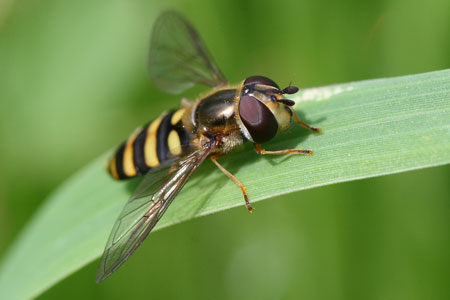
"Hoverflies, sometimes called flower flies or syrphid flies, make up the insect family Syrphidae. As their common name suggests, they are often seen hovering or nectaring at flowers; the adults of many species feed mainly on nectar and pollen, while the larvae (maggots) eat a wide range of foods. In some species, the larvae are saprotrophs, eating decaying plant and animal matter in the soil or in ponds and streams. In other species, the larvae are insectivores and prey on aphids, thrips, and other plant-sucking insects.
About 6,000 species in 200 genera have been described. Hoverflies are common throughout the world and can be found on all continents except Antarctica. Hoverflies are harmless to most other animals, despite their mimicry of more dangerous wasps and bees, which wards off predators.
Hoverflies are important pollinators of flowering plants in a variety of ecosystems worldwide.[10] Syrphid flies are frequent flower visitors to a wide range of wild plants as well as agricultural crops and are often considered the second most important group of pollinators after wild bees. However, there has been relatively little research into fly pollinators compared with bee species.[10] It is thought that bees are able to carry a greater volume of pollen on their bodies, but flies may be able to compensate for this by making a greater number of flower visits.
Like many pollinator groups, syrphid flies range from species that take a generalist approach to foraging by visiting a wide range of plant species to those that specialize in a narrow range of plants. Although hoverflies are often considered mainly non-selective pollinators, some hoverflies species are highly selective and carry pollen from one plant species. ...
Many syrphid fly species have short, unspecialized mouth parts and tend to feed on flowers that are more open as the nectar and pollen can be easily accessed."
~Wikipedia.org
This company makes flying cameras: www.hoverflytech.com
This website gives a great deal more information on the nature and nomenclature of the hoverfly, and includes a picture of the larvae.
This Wikipedia article talks about the Sikorsky R-4/Hoverfly helicopter, "the first helicopter used by the United States Army Air Forces..."
Subscribe to:
Comments (Atom)