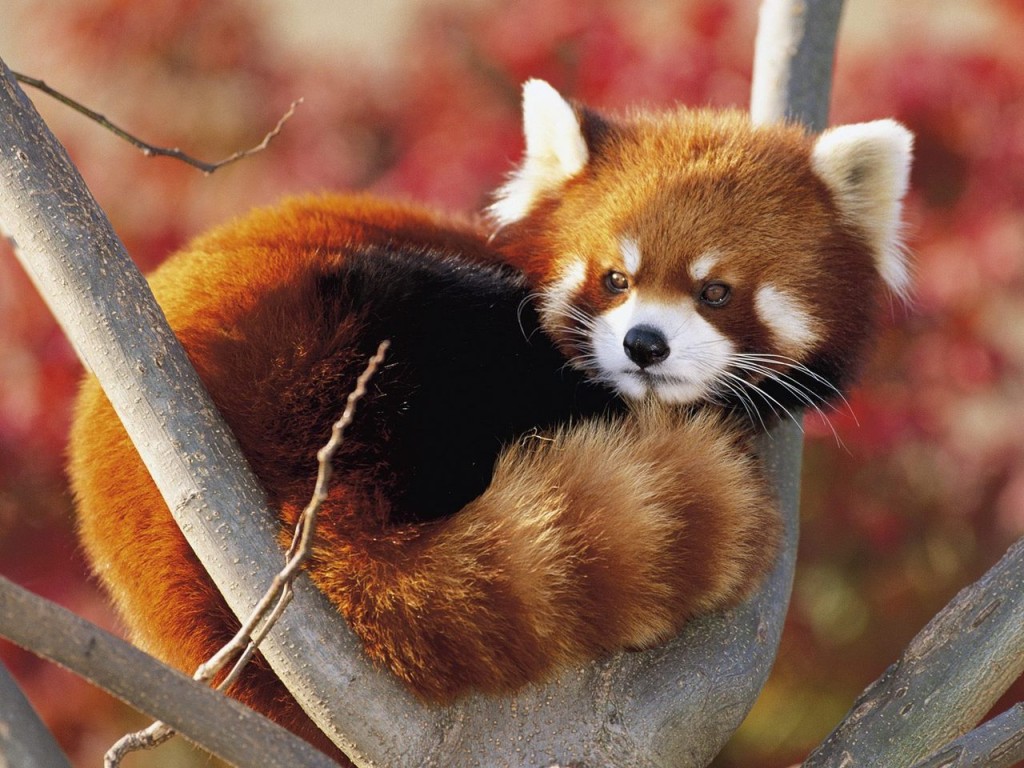
"The red panda (Ailurus fulgens), also called lesser panda, red bear-cat and red cat-bear, is a small arboreal mammal native to the eastern Himalayas and south-western China that has been classified as vulnerable by IUCN as its wild population is estimated at less than 10,000 mature individuals. The population continues to decline and is threatened by habitat loss and fragmentation, poaching, and inbreeding depression, although red pandas are protected by national laws in their range countries.
The red panda is slightly larger than a domestic cat. It has reddish-brown fur, a long, shaggy tail, and a waddling gait due to its shorter front legs. It feeds mainly on bamboo, but is omnivorous and also eats eggs, birds, insects, and small mammals. It is a solitary animal, mainly active from dusk to dawn, and is largely sedentary during the day.
The red panda is the only living species of the genus Ailurus and the family Ailuridae. ...which along with the weasel, raccoon and skunk families is part of the superfamily Musteloidea. Two subspecies are recognized. It is not closely related to the giant panda.
The red panda is territorial; it is solitary except during mating season. The species is generally quiet except for some twittering, tweeting, and whistling communication sounds. It has been reported to be both nocturnal and crepuscular, sleeping on tree branches or in tree hollows during the day and increasing its activity in the late afternoon and early evening hours. It sleeps stretched out on a branch with legs dangling when it is hot, and curled up with its tail over the face when it is cold. This panda is very heat sensitive, with an optimal “well-being” temperature between 17 and 25 °C (63 and 77 °F), and cannot tolerate temperatures over 25 °C (77 °F).
Red panda standing
Shortly after waking, red pandas clean their fur like a cat, licking their front paws and then rubbing their backs, stomachs and sides. They also rub their backs and bellies along the sides of trees or rocks. Then they patrol their territories, marking with urine and a weak musk-smelling secretion from their anal glands. They search for food running along the ground or through the trees. Red pandas may alternately use their forepaws to bring food to their mouths or place food directly into their mouths.
Predators of the red panda include the snow leopard, martens (Mustelidae), and humans. If they feel threatened or sense danger, they may try to escape by climbing a rock column or tree. If they can no longer flee, they stand on their hind legs to make themselves appear larger and use the sharp claws on their front paws to defend themselves.
Red pandas are excellent climbers, and forage largely in trees. They eat mostly bamboo, and may eat small mammals, birds, eggs, flowers and berries. In captivity, they were observed to eat birds, flowers, maple and mulberry leaves, and bark and fruits of maple, beech and mulberry.
Like the giant panda, they cannot digest cellulose, so they must consume a large volume of bamboo to survive. Their diets consist of about two-thirds bamboo, but they also eat mushrooms, roots, acorns, lichen and grasses. Occasionally, they supplement their diets with fish and insects."
~Wikipedia.org
